

Last verified: August 20, 2026.
Hosted API access update — August 20, 2026: MiniMax says paid Music Generation and Lyrics Generation APIs are no longer available to new users; existing paying users can continue using their current API services. The free IDs
music-3.0-free,music-2.6-free, andmusic-cover-freeare discontinued. New users are directed to MiniMax Audio or the downloadable MiniMax Music 3 checkpoint. The checkpoint is a separate open-weight route under its Community License and is not the hosted Lyrics or Music Cover API. Some operation schemas still display the former free IDs, so schema visibility must not be treated as current entitlement.
MiniMax Music 3.0 now has two distinct developer routes: retained hosted Music Generation access for eligible existing paying accounts and downloadable model weights published under the custom MiniMax-Music3 Community License. The hosted schema still displays music-3.0 and the discontinued music-3.0-free ID. The local route uses MiniMaxAI/MiniMax-Music3. These identifiers, endpoints, output settings, limits, costs, and licenses are not interchangeable.
MiniMax first listed Music-3.0 in its API release log on July 16, 2026. On August 13, 2026, the company published a separate research announcement describing Music 3.0 as an open-weights model and linked a first-party checkpoint, repository, demo, and deployment instructions. That later release makes the previous “hosted only” description obsolete.
This is an independent, documentation-based guide. We have not published a controlled listening benchmark for Music 3.0. Statements about stronger creative-intent understanding, cleaner mixes, more realistic instruments, and more natural vocals are MiniMax’s claims, not independently measured findings on this page.
Bottom line: use the hosted API when you want managed infrastructure, documented request fields, and existing paid-account access. Evaluate the local checkpoint when data placement, customization, or infrastructure control justifies running a large CUDA workload. The API costs $0.15 per generated piece of music up to five minutes at the verified pay-as-you-go price; the downloadable weights have no per-generation MiniMax API fee, but compute, storage, engineering, and license compliance remain your responsibility.
MiniMax Music 3.0 at a Glance
| Specification | Hosted API | Local open-weight route |
|---|---|---|
| Hosted schema identifiers | music-3.0 and music-3.0-free |
MiniMaxAI/MiniMax-Music3 |
| Primary endpoint | POST https://api.minimax.io/v1/music_generation |
Framework-dependent; the SGLang-Omni example serves POST http://127.0.0.1:8000/v1/audio/speech |
| Access | Eligible existing paying account only; new API access is closed and the free ID is discontinued | Download from the official Hugging Face repository |
| Price | $0.15 legacy list price for eligible existing paying accounts; no active free API route | No MiniMax per-call API price; you pay your own infrastructure and operations costs |
| Service limits | Published existing-paid limit: 120 RPM and 20 concurrent connections; the free route is discontinued | No hosted RPM limit; capacity depends on your hardware and serving stack |
| Input limit | Prompt up to 2,000 characters; lyrics up to 3,500 characters for a normal vocal request | Tokenized text prompt up to 5,000 tokens; audio generation up to 9,000 acoustic frames |
| Output | MP3, WAV, or PCM; URL or hexadecimal delivery; supported sample rates up to 44.1 kHz | 32 kHz, 16-bit stereo WAV in the first-party model examples |
| Streaming | Available only with hexadecimal output | Not supported in the published local instructions |
| License | MiniMax Open Platform terms and the terms attached to your account or plan | MiniMax-Music3 Community License, including commercial-use conditions and an Acceptable Use Policy |
| Infrastructure | Managed by MiniMax | CUDA required; exact GPU requirements depend on the framework and offloading strategy |
The two routes expose related Music 3 technology, but the official sources do not establish that every hosted and local implementation detail is identical. Treat them as separate deployment products and test the exact route you intend to ship.
What Is MiniMax Music 3.0?
MiniMax Music 3.0 is a text-to-music and lyrics-to-song model. It can generate a vocal song from a music description and supplied lyrics, generate lyrics automatically in the hosted API, or create instrumental music. MiniMax says the model can sustain a complete song for up to five minutes while following long-range structure, vocal direction, instrumentation, arrangement, and production cues.
The model is part of MiniMax’s music family, not its M-series language-model family. It is also separate from MiniMax Speech, which is designed for speech generation, and from music-cover, which is a distinct hosted model for creating a new rendition from reference audio. See the MiniMax models directory for the wider model map.
Release timeline
| Date | Verified event | Why it matters |
|---|---|---|
| July 16, 2026 | MiniMax’s model release log lists Music-3.0. | Establishes the hosted model release date used by the API documentation. |
| August 13, 2026 | MiniMax publishes its open-weights research announcement and first-party Music 3 repository. | Changes the access story from hosted-only to hosted plus local weights. |
| August 14, 2026 | The official Hugging Face repository metadata shows a last modification on this date. | The current model card documents Diffusers, ComfyUI, CUDA, and low-VRAM guidance; local instructions should be rechecked before deployment. |
| August 15, 2026 | This independent guide was reverified against the current first-party sources. | Hosted and local identifiers, pricing, rate limits, hardware notes, and license terms are separated below. |
Architecture and the Qwen Source Conflict
MiniMax describes a hierarchical architecture with an 8B Global LLM for long-range musical structure, a 0.6B Local LLM for within-frame acoustic detail, a 2.4B flow-matching module, and a 123M Flow-VAE decoder. The repository also documents eight residual-vector-quantization codebooks: a first semantic codebook followed by seven acoustic codebooks.
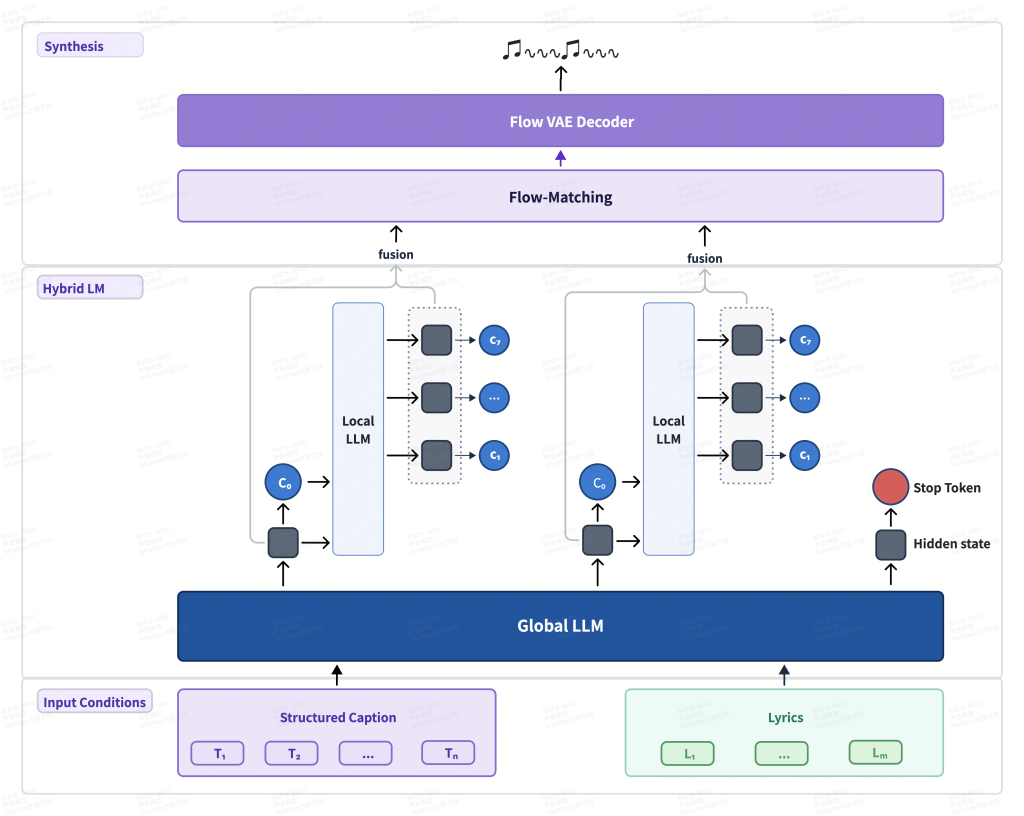
Official-source conflict: MiniMax’s August 13 research article says the 8B Global LLM was initialized from
Qwen3.5-8B. The current official GitHub README, Hugging Face model card, and Community License instead sayQwen3-8B. Those first-party sources disagree. Until MiniMax reconciles them, the defensible wording is “an 8B Global LLM”; do not present either Qwen base as an uncontested fact.
Architecture descriptions do not prove output quality for a particular genre, language, vocal style, or production workflow. Use the official examples for orientation, then run matched prompts and human listening tests on the deployment route you plan to use.
Music 3.0 vs Music 2.6
MiniMax lists Music 3.0 as the recommended hosted text-to-music model and Music 2.6 as previous-generation. The company attributes improvements to creative-intent interpretation, mix clarity, instrument detail, playing techniques, pronunciation, breathing, melody, and layered harmonies. These remain vendor-reported improvements; MiniMax’s API guide does not provide a scored matched-prompt listening benchmark.
| Area | Music 3.0 | Music 2.6 | Practical decision |
|---|---|---|---|
| Hosted status | Recommended | Previous-generation | Evaluate 3.0 first for a new hosted integration. |
| Paid API ID | music-3.0 |
music-2.6 |
Use exact IDs; do not substitute marketing names. |
| Former free API ID | music-3.0-free |
music-2.6-free |
Both free IDs remain visible in the schema, but MiniMax’s August 20 notice says they are discontinued. |
| Paid list price | $0.15 for music up to five minutes | $0.15 for music up to five minutes | List price alone does not decide migration. |
| Paid service limit | 120 RPM; Music Generation table also lists 20 CONN | 120 RPM; same Music Generation table scope | Measure latency, failures, and queue behavior in your own account. |
| First-party local checkpoint | MiniMaxAI/MiniMax-Music3 is available |
Not assessed on this page | Local deployment is now a documented Music 3.0 option. |
| Quality claims | MiniMax reports stronger intent, mix, instrument, and vocal behavior | Earlier generation | Validate with blinded, matched-input listening tests. |
A responsible migration test
- Freeze a set of original prompts and lyrics spanning the genres, languages, vocal types, and durations you actually use.
- Use identical hosted output settings when comparing
music-3.0withmusic-2.6. - Blind model names during listening review when practical.
- Score prompt adherence, lyric intelligibility, vocal artifacts, melody, arrangement, instrument separation, endings, failures, latency, and total cost.
- Test the hosted and local routes separately; different runtimes and output formats make them operationally different.
- Move production traffic gradually and retain a rollback path until acceptance thresholds are met.
Hosted MiniMax Music 3.0 API
The hosted route uses MiniMax’s modality-specific Music Generation endpoint, not the OpenAI-compatible chat endpoint. Create the API key only in the official MiniMax platform and store it in a server-side secret manager or environment variable. Never expose it in browser JavaScript, a public repository, a mobile binary, or a WordPress page. Our MiniMax API guide explains the wider account and endpoint workflow.
POST https://api.minimax.io/v1/music_generation
Authorization: Bearer YOUR_MINIMAX_API_KEY
Content-Type: application/json
Hosted model IDs and limits
| Route | Exact ID | Access | Published limit |
|---|---|---|---|
| Hosted paid API | music-3.0 |
Eligible existing paying users only; verify the account console | 120 RPM and 20 concurrent connections remain published technical ceilings for entitled accounts |
| Former free API | music-3.0-free |
Discontinued August 20, 2026 | The schema still shows a historical 3-RPM value; this is not current availability |
| Reference-audio cover | music-cover for an eligible existing paying account; music-cover-free discontinued |
Separate cover workflow | Not an alias or mode name for Music 3.0 |
Hosted request rules
| Field | Documented rule | Practical note |
|---|---|---|
model |
Required | For an eligible existing paying account, use music-3.0; music-3.0-free is discontinued. |
prompt |
0–2,000 characters for a normal vocal request; 1–2,000 for instrumental mode | Describe style, mood, scenario, instruments, vocals, arrangement, and production direction. |
lyrics |
1–3,500 characters for a normal vocal request | Not required for instrumental mode or when automatic lyrics are enabled with an empty lyrics value. |
lyrics_optimizer |
Boolean; default false |
Set to true with empty lyrics to ask the hosted service to generate lyrics. |
is_instrumental |
Boolean; default false |
Set to true to generate without vocals. |
stream |
Boolean; default false |
Hosted streaming supports hexadecimal output only. |
output_format |
url or hex; default hex |
URL output expires after 24 hours. |
audio_setting.format |
mp3, wav, or pcm |
These are hosted API choices, not a promise about every local runtime. |
audio_setting.sample_rate |
16,000; 24,000; 32,000; or 44,100 Hz | Confirm downstream compatibility. |
audio_setting.bitrate |
32,000; 64,000; 128,000; or 256,000 | Bitrate is relevant to encoded output. |
Hosted API example
This example sends original sample lyrics, requests URL delivery, and prints the full response so your application can inspect both HTTP status and MiniMax’s own status fields.
curl --request POST \
  --url https://api.minimax.io/v1/music_generation \
  --header "Authorization: Bearer $MINIMAX_API_KEY" \
  --header "Content-Type: application/json" \
  --data '{
    "model": "music-3.0",
    "prompt": "Warm acoustic pop, intimate lead vocal, fingerpicked guitar, soft piano, restrained verses, a wider final chorus, and a clean resolved ending.",
    "lyrics": "[Verse]\nMorning light across the road\n[Chorus]\nCarry the spark and bring it home",
    "stream": false,
    "output_format": "url",
    "audio_setting": {
      "sample_rate": 44100,
      "bitrate": 256000,
      "format": "mp3"
    }
  }'
Do not start a new integration with music-3.0-free: MiniMax says the free route is discontinued. The request example remains relevant only to an eligible existing paying account using music-3.0.
Hosted pricing and throughput
| Item | Verified price | Published limit | Budget example |
|---|---|---|---|
music-3.0 |
$0.15 per generated piece up to five minutes | 120 RPM; 20 CONN for Music Generation | 100 successful generations at list price: $15 |
music-3.0-free |
Discontinued | Historical schema value: 3 RPM | Not a current evaluation route |
| Lyrics Generation | $0.01 per song | Check the applicable account limit | 100 standalone lyric calls at list price: $1 |
| Paid lyrics plus paid music | $0.16 combined list price | Each endpoint’s applicable limit | One lyric call plus one Music 3.0 generation |
“Up to five minutes” is the published pricing unit. The hosted request schema does not provide a duration field, so do not promise an exact user-selected length or assume every output will be five minutes. RPM measures request starts per minute; CONN is concurrent work. Neither number is a latency guarantee, daily quota, success-rate promise, or service-level agreement. Recheck the MiniMax pricing guide and MiniMax API rate-limit guide before budgeting a production workload.
Local MiniMax Music 3.0 Open Weights
MiniMax publishes the downloadable checkpoint at Hugging Face: MiniMaxAI/MiniMax-Music3 and maintains first-party examples in the MiniMax-Music3 GitHub repository. Call this an open-weight release under a custom Community License, not an unqualified “open-source” model.
Download the checkpoint
hf download MiniMaxAI/MiniMax-Music3 --local-dir /path/to/minimax_ttmPlan storage before downloading. The repository contains large model files, and local operation also needs room for runtime dependencies, caches, outputs, and temporary files. Check the live repository file list rather than relying on a copied size figure.
Supported first-party paths
| Framework path | What the official source documents | Hardware note |
|---|---|---|
| SGLang-Omni | Serve the checkpoint locally, then generate through a shared /v1/audio/speech route. |
The GitHub README describes a two-CUDA-GPU split: one GPU for Qwen/RVQ autoregression and one for flow matching and waveform decoding. |
| Diffusers | The current Hugging Face card provides a modular-pipeline example with a selectable audio_duration. |
The model card presents a 24GB-class path, says automatic CPU offloading uses about 22GB, and says layer streaming can fit an 8GB GPU at a speed cost. |
| ComfyUI | The current Hugging Face card links an official ComfyUI tutorial. | No universal VRAM or speed guarantee is stated in the MiniMax model card; verify the current tutorial and workflow. |
These are framework-specific statements, not one universal minimum specification. “Two GPUs for the documented SGLang path” and “an 8GB low-VRAM Diffusers path” can both be true because the runtimes use different loading and offloading strategies. Low-VRAM operation may be substantially slower and can move pressure to system memory and storage.
Serve with SGLang-Omni
sgl-omni serve --model-path MiniMaxAI/MiniMax-Music3 --port 8000The published SGLang examples use a local speech-compatible endpoint, with lyrics in input and the music description in instructions:
curl http://127.0.0.1:8000/v1/audio/speech \
  -H "Content-Type: application/json" \
  -d '{
    "model": "MiniMaxAI/MiniMax-Music3",
    "input": "[Verse]\nMorning light across the road\n[Chorus]\nCarry the spark and bring it home",
    "instructions": "Warm acoustic pop with intimate vocals, fingerpicked guitar, soft piano, and a gradual final lift.",
    "response_format": "wav",
    "seed": 7,
    "max_new_tokens": 750,
    "stream": false
  }' \
  --output music3-local.wav
Implementation caution: first-party examples have changed. The current Hugging Face card uses MiniMaxAI/MiniMax-Music3 in the local request, while the GitHub README has also shown minimax_ttm. Verify the model field accepted by the exact SGLang-Omni version you install instead of treating either copied example as a permanent API contract.
Local runtime limits
- CUDA is required by the published local instructions.
- Local generation is non-streaming in the current model card.
- The tokenized text prompt is limited to 5,000 tokens.
- Audio generation is limited to 9,000 acoustic frames.
- The model card explains that
max_new_tokenscontrols audio frames at 25 frames per second; generation may stop earlier when an end-of-audio token is emitted. - The output in the first-party examples is 32 kHz, 16-bit stereo WAV.
- Section tags, tempo, key, instrumentation, lyrics, and structure are generative controls, not strict symbolic guarantees.
Do not apply the hosted API’s 2,000-character prompt limit, 3/120 RPM figures, output URL expiry, or MP3 settings to the local route. Likewise, do not apply the local route’s 5,000-token prompt limit, CUDA requirement, or 32 kHz WAV example to the managed API. They are different interfaces with different documented constraints.
First-party demo and reproducible sample
MiniMax provides a Music 3 demo page. The Hugging Face repository also pairs a complete local-generation script with its corresponding WAV output. These are useful first-party examples because the request and output can be inspected together. They remain vendor-selected demonstrations, not a representative benchmark or a guarantee that a different prompt, seed, runtime, or revision will produce the same quality.
MiniMax Music 3 License and Commercial Use
The weights are governed by the MiniMax-Music3 Community License. It grants broad rights to use, copy, modify, distribute, sublicense, and provide copies of the software, including the model weights, subject to its conditions. It is a custom license, so do not reduce it to “free for anything” or assume that a generic open-source policy covers it.
| Material term | What the license requires | Operational action |
|---|---|---|
| Notices | Include the copyright and permission notice in copies or substantial portions. | Preserve notices in distributions and derivative packages. |
| Commercial attribution | A commercial product or service using the software must prominently display “MiniMax-Music3” in its user interface. | Add the required product attribution before launch. |
| Revenue threshold | Separate prior written MiniMax authorization is required when aggregate yearly revenue from the relevant products and services of you and/or affiliates exceeds $20 million. | Escalate to legal/procurement and contact the address specified in the license before crossing the threshold. |
| Hosted generation safeguards | A third-party product or hosted service that permits generation must implement, maintain, test, and periodically review safeguards against prohibited or rights-violating use and output. | Document moderation, abuse prevention, review, and incident processes. |
| Acceptable Use Policy | The license includes prohibited-use categories and may be updated. | Read the current exhibit, map it to product controls, and recheck it before release. |
| Warranty and risk | The software is provided as-is without warranty, and users assume deployment and output risks. | Do not present the model as warranted, infringement-free, or production-safe by default. |
The license also identifies Qwen3-8B under Apache 2.0 and components derived from Stable Audio and DAC under MIT licenses. That statement is one side of the Qwen-version conflict noted above. Review all incorporated notices and the complete current license rather than relying on this summary.
Hosted API use is governed separately by the MiniMax Open Platform Terms and any plan-specific terms. Rights and obligations from the local Community License should not be copied onto the hosted service, or vice versa. This section is an editorial summary, not legal advice.
How to Write Better Music 3.0 Prompts
Treat the music description as a producer brief. Start with the broad direction, then describe the elements that need to evolve across the track:
[genre and subgenre] + [mood and energy] + [tempo/key guidance] + [vocal character] + [instruments and techniques] + [arrangement arc] + [production profile] + [intended use]| Prompt element | Useful detail | Example wording |
|---|---|---|
| Genre | Main style plus a compatible subgenre | Alternative pop with dream-pop textures |
| Mood | Emotional direction and how it changes | Intimate at first, gradually becoming hopeful |
| Tempo and key | Creative guidance, not a guaranteed symbolic control | Mid-tempo feel around 96 BPM in C major |
| Vocals | Range, timbre, delivery, harmony, and effects | Warm lower-register lead, clear diction, restrained verse, layered chorus |
| Instruments | Lead and supporting instruments plus techniques | Fingerpicked guitar, legato strings, soft piano, brushed drums |
| Arrangement | How sections enter, grow, contrast, and end | Sparse intro, fuller second verse, lifted final chorus, resolved ending |
| Production | Mix and spatial character | Wide but uncluttered mix, dry lead vocal, controlled reverb |
| Use case | What the track must leave room for | Background music that stays clear under narration |
- Avoid contradictory directions unless the arrangement explains when each direction should appear.
- Name instruments by role: lead, rhythm, bass, texture, transition, or accent.
- Describe vocal qualities instead of requesting imitation of a recognizable artist.
- Put lyric section tags on their own lines.
- Change one important prompt variable at a time when refining an output.
- State how the track should end and what it must not overpower.
Practical Music 3.0 Prompt Examples
1. Vocal pop song
Bright alternative pop with an uplifting mid-tempo groove, expressive lead vocal with clear diction, tight live drums, warm bass, shimmering guitars, restrained verse, rising pre-chorus, wide melodic chorus with layered harmonies, clean modern mix, and a resolved ending.The prompt defines a section arc and instrument roles. Vocal descriptions are creative directions, not a hosted API voice selector.
2. Cinematic instrumental
Dark cinematic instrumental, slow-building tension, low cellos and basses, distant metallic pulses, restrained frame drums, expressive legato violin, brief silence before the final rise, powerful but uncluttered climax, no vocals, and a clean ending.For the hosted API, use this with is_instrumental: true. For the local checkpoint, put the same direction in instructions or the framework’s prompt field.
3. YouTube background track
Relaxed electronic-pop instrumental for a productivity video, gentle 96 BPM feel, muted guitar, soft synth pads, rounded bass, light percussion, positive but unobtrusive mood, minimal melodic movement under narration, smooth transitions, and a clean ending.The prompt prioritizes space for speech. See the MiniMax workflow for YouTube creators for scripting, speech, music, video, and review steps.
4. Indie game exploration cue
Cozy exploration instrumental, soft marimba lead, fingerpicked nylon guitar, warm pads, light hand percussion, playful woodwind accents, gentle sense of discovery, low dynamic range, no large climax, and a closing phrase that can transition toward the opening mood.“Loop-friendly” or similar wording expresses intent; it does not guarantee a technically seamless loop. Inspect and edit loop points in an audio workstation.
Strengths and Limitations
| Documented strength | Qualification |
|---|---|
| Complete-song generation up to five minutes | Do not treat this as an exact duration selector or a guarantee that every output reaches five minutes. |
| Lyrics plus detailed music descriptions | Tempo, key, instruments, lyrics, and structure are generative controls, not strict guarantees. |
| Hosted API availability | The free ID is discontinued; eligible existing paying accounts remain subject to the published 120-RPM/20-CONN ceilings and account controls. |
| First-party downloadable weights | Local deployment requires CUDA, large model files, engineering work, and license compliance. |
| SGLang, Diffusers, and ComfyUI paths are referenced | Hardware requirements and behavior differ by runtime; first-party examples have changed quickly. |
| Hosted MP3, WAV, and PCM settings | The local examples produce 32 kHz, 16-bit stereo WAV; do not assume hosted and local formats match. |
| Automatic lyrics and instrumental fields in the hosted API | Generated lyrics require editorial and rights review; local interfaces expose different fields. |
| MiniMax reports better intent, instruments, mix, and vocals | This page has no independent controlled listening benchmark. |
The cited sources do not document separate stems, MIDI, project files, chord charts, isolated vocals, or a digital-audio-workstation session as standard outputs. If a project requires them, plan additional editing or source-separation work and validate its quality and licensing.
Copyright, Voice, and Release Safety
Do not label every Music 3.0 output “royalty-free,” “commercially cleared,” or “copyright guaranteed.” Input rights, output similarity, the access route, the local Community License or hosted terms, local law, and the publishing platform all matter.
- Use original lyrics and audio, or material you are authorized to submit and transform.
- Do not use another person’s voice, demo, recording, or identity without valid permission.
- Review outputs for similarity to existing melodies, lyrics, hooks, recordings, and vocal identities.
- Apply the Community License’s attribution, safeguards, disclosure, and prohibited-use requirements to a local commercial product.
- Keep a project record containing the route, model ID, model revision, prompt, lyrics, seed where applicable, generation date, output, and approvals.
- Check current disclosure and synthetic-media rules for the relevant country and publishing platform.
- Obtain qualified legal advice for high-value releases, client campaigns, disputed material, or uncertain rights.
For a wider handling checklist, see what not to paste into MiniMax AI and MiniMax AI for business.
Hosted API or Local Weights?
| Choose the hosted API when… | Evaluate local weights when… |
|---|---|
| You want the fastest path to a managed integration. | You need infrastructure control or local data placement. |
| Per-generation billing is easier than operating GPUs. | Expected utilization may justify owning the compute stack. |
| The documented API fields and output formats fit your product. | You need framework-level control, reproducibility, or deeper engineering access. |
| MiniMax-managed scaling and service controls are acceptable. | Your team can operate CUDA workloads, storage, monitoring, moderation, and updates. |
| The Open Platform terms fit the workload. | Your legal and product teams can comply with the Community License. |
Do not choose local deployment solely to avoid the $0.15 API unit price. Compare total GPU time, engineering, monitoring, storage, moderation, redundancy, update work, and license compliance. Do not choose the hosted route solely for convenience without checking data handling, account limits, and customer obligations.
Frequently Asked Questions
Is MiniMax Music 3.0 hosted or downloadable?
For new users, the downloadable route remains available. Eligible existing paying users may still use the hosted API with music-3.0; music-3.0-free is discontinued. The checkpoint uses MiniMaxAI/MiniMax-Music3. These routes have separate interfaces, limits, costs, and terms.
Is Music 3.0 open source?
MiniMax calls it open weights. The checkpoint is released under the custom MiniMax-Music3 Community License, not a generic unrestricted license. “Open-weight under a Community License” is the more precise description.
Can I use the local weights commercially?
The Community License grants commercial-use rights subject to conditions. Material terms include prominent “MiniMax-Music3” display in a commercial interface, separate prior written authorization above the license’s $20 million aggregate-yearly-revenue threshold, safeguards for third-party generation services, notices, and the Acceptable Use Policy. Read the complete current license and obtain legal advice for your deployment.
How much does the hosted Music 3.0 API cost?
MiniMax’s pay-as-you-go page lists music-3.0 at $0.15 per generated piece of music up to five minutes. The same table still shows music-3.0-free, but MiniMax’s August 20 notice says that free ID is discontinued; the $0.01 Lyrics figure is relevant only to eligible existing paying accounts. Recheck the pricing page before budgeting.
What are the API rate limits?
The paid Music Generation table lists 120 requests per minute and 20 concurrent connections. The schema still shows a historical 3-RPM value for the free ID, but MiniMax says that route is discontinued. Account-specific controls or approved increases may differ.
What hardware do the local weights require?
CUDA is required by the current first-party model card. The GitHub SGLang-Omni path describes two CUDA GPUs. The Hugging Face Diffusers guidance presents a 24GB-class route, about 22GB with automatic CPU offload, and a slower layer-streaming option that can fit an 8GB GPU. Treat each statement as framework-specific and verify the current instructions before buying hardware.
Does local Music 3.0 support streaming?
The current first-party local model card says only non-streaming generation is supported. The hosted API has a separate streaming option, but it supports hexadecimal output only.
How long can a Music 3.0 song be?
MiniMax describes complete songs up to five minutes. The hosted schema does not expose a duration field. Local frameworks may expose frame or duration controls, but the 9,000-frame ceiling should not be turned into a promise that every output will reach a particular length.
Which Qwen model is Music 3 based on?
MiniMax’s official sources currently disagree. The research article says Qwen3.5-8B, while the GitHub README, Hugging Face card, and Community License say Qwen3-8B. Until MiniMax corrects or explains the difference, use the neutral description “8B Global LLM.”
Is Music Cover part of Music 3.0?
No. The hosted reference-audio workflow uses music-cover only for eligible existing paying accounts; music-cover-free is discontinued. It shares the Music Generation API but is a separate model choice. See the MiniMax Music Cover API guide.
Can the hosted API generate lyrics automatically?
Yes. Set lyrics_optimizer to true and leave lyrics empty, or use the separate Lyrics Generation endpoint. See the MiniMax Lyrics API guide.
Are hosted and local outputs identical?
The reviewed first-party sources do not establish output identity across routes. The interfaces and documented output settings differ. Compare them with the same approved inputs and a defined listening rubric before treating them as substitutes.
Official Sources
- MiniMax Music 3.0 open-weights research announcement — release positioning, architecture, and vendor-reported capabilities.
- MiniMax model release notes — July 16, 2026 API-model release date.
- MiniMax Music Generation guide — hosted workflow and vendor-reported improvements.
- MiniMax Music Generation API reference — endpoint, IDs, fields, input limits, and output behavior.
- MiniMax pay-as-you-go pricing — legacy hosted price and current availability notice.
- MiniMax API rate limits — paid Music Generation RPM and concurrency.
- Official MiniMax Music 3 model card on Hugging Face — checkpoint ID, frameworks, current local examples, output, and runtime limits.
- Official MiniMax Music 3 GitHub repository — SGLang-Omni setup, architecture, demo, and repository examples.
- MiniMax-Music3 Community License — controlling local-weight license and Acceptable Use Policy.
Source review date: August 15, 2026. Prices, model cards, runtime instructions, license terms, and limits can change. Recheck the linked first-party source before a purchase, deployment, or public claim.
Update Log
- August 15, 2026: replaced the obsolete hosted-only description; added the official open-weight checkpoint, local frameworks and limits, Community License terms, route-specific identifiers, source conflicts, and separate hosted/local examples.
- August 20, 2026: scoped hosted access to eligible existing paying users, marked the free IDs discontinued, and added the official new-user alternatives.
- July 17, 2026: verified the initial hosted API guide, pricing, free ID, request fields, and Music 2.6 comparison.
- July 16, 2026: initial page published for the Music-3.0 API release.
Conclusion
MiniMax Music 3.0 is no longer accurately described as a hosted-only music model. New users can use MiniMax Audio or download MiniMaxAI/MiniMax-Music3. Only eligible existing paying users can continue the managed music-3.0 API; music-3.0-free is discontinued. The best route depends on workload, data placement, engineering capacity, hardware, total cost, and license obligations.
For an eligible existing paid hosted account, preserve the music-3.0 ID, Music Generation endpoint, $0.15 legacy list price, 120-RPM/20-CONN technical limits, and 24-hour URL-output rule; the former free route is discontinued. For local weights, preserve the official checkpoint ID, CUDA and non-streaming requirements, 5,000-token prompt limit, 9,000-frame ceiling, framework-specific GPU guidance, and custom Community License.
Finally, treat quality language as a claim to test, not a result already proven for your use case. Use approved inputs, matched prompts, a documented review rubric, rights checks, and a rollback plan. The MiniMax Music API guide covers the broader hosted implementation, while the MiniMax Music vs Suno vs Udio comparison covers the product-level decision.