

Last verified: August 26, 2026.
Independent guide: MiniMax-AI.chat is not affiliated with MiniMax or Moonshot AI. This page compares documented products and APIs; it does not report a controlled quality benchmark. The chat on this website is a separate, independent, text-only demo limited to 1,000 characters per message. It does not provide the full MiniMax M3, MiniMax Agent, Kimi K3, Kimi Code, file-upload or media-generation experience.
MiniMax AI vs Kimi AI is no longer a comparison between MiniMax M3 and only Kimi K2.7 Code. Moonshot AI released Kimi K3 on July 17, 2026, so the fair general-model comparison is MiniMax M3 versus Kimi K3. Kimi K2.7 Code remains relevant as a separate coding-focused model with a smaller 256K context window.
There is no universal winner. M3 has lower listed direct-API rates in the pricing snapshot below and selectable reasoning modes. Both M3 and K3 now publish model weights under their respective licenses, while K2.7 Code also remains available for local deployment. K3 has a documented focus on long-horizon coding and end-to-end knowledge work, always-on reasoning, dynamic tool loading and a million-token context. Those documented differences identify sensible candidates to test; they do not prove which model will retrieve facts, edit your repository or call your tools more accurately.
Quick verdict
| Requirement | Candidate to test first | Documented reason |
|---|---|---|
| General coding, agents and multimodal understanding | MiniMax M3 and Kimi K3 | Both list million-token context, text/image/video input and tool-oriented workflows. |
| Lower listed direct-API token rates | MiniMax M3 | M3 standard rates are lower than K3 rates in the official pricing pages checked on the verification date. |
| A model explicitly dedicated to coding | Kimi K2.7 Code | Kimi documents it as a coding-focused model for code generation, editing and programming agents. |
| Downloadable weights now | MiniMax M3, Kimi K3, or Kimi K2.7 Code | M3, K3, and K2.7 Code all have published weight repositories; compare their licenses, hardware requirements, and serving infrastructure. |
| Broader provider media-generation catalog | MiniMax platform | MiniMax separately offers Hailuo video, speech, music and image-generation models. |
| Kimi’s terminal, productivity and agent products | Kimi ecosystem | Kimi documents Kimi Code, web/app agents and knowledge-work workflows as first-party products. |
Bottom line: shortlist exact model IDs, not company names. Compare MiniMax-M3 with kimi-k3 for broad agent and multimodal work. Include kimi-k2.7-code when coding specialization is central. Choose only after a same-task evaluation with a fixed budget and review rubric.
Scope and methodology
This is a documentation comparison. We checked provider model pages, API documentation, pricing tables and official repositories on the date above. We did not run a controlled head-to-head evaluation, so vendor benchmarks and marketing descriptions are treated as provider-reported evidence, not independent proof.
- Model scope: MiniMax M3 versus Kimi K3 for the general comparison; Kimi K2.7 Code is discussed only where its coding specialization matters.
- Context scope: published capacity is recorded as a specification. Context capacity alone does not measure retrieval accuracy, instruction retention or resistance to distraction.
- Price scope: direct pay-as-you-go API list prices, excluding taxes, promotions, membership allowances, retry costs and self-hosting infrastructure.
- Product scope: provider web apps, coding products, APIs and downloadable weights are separated because their features, data handling and billing can differ.
- Decision standard: cost per accepted result, task completion, unsafe edits, tool-call accuracy, latency and reviewer time.
Documented facts: MiniMax M3 vs Kimi K3
| Fact | MiniMax M3 | Kimi K3 |
|---|---|---|
| Provider | MiniMax | Moonshot AI / Kimi |
| Release referenced here | June 1, 2026 | July 17, 2026 |
| Published scale | About 428B total parameters and 23B activated | 2.8T total parameters; official documentation describes 16 of 896 experts activated |
| Context | Up to 1M combined input/output tokens; official M3 page states a guaranteed minimum of 512K for the API | 1,048,576-token context window |
| Input and output | Text, image and video input; text output in the language-model API | Text, image and video input; text output |
| Reasoning controls | enabled, adaptive or disabled | Reasoning is always enabled; reasoning_effort supports low, high, and max; the documented default is max |
| API compatibility | Anthropic-compatible path is recommended; OpenAI-compatible Chat Completions and Responses paths are also documented | OpenAI-compatible Chat Completions |
| Tool features | Tool use and interleaved thinking | Tool calls, tool-choice constraints, dynamic tool loading and official Formula tools |
| Weights | Downloadable open weights under the MiniMax Community License | Full weights are published under the Kimi K3 License |
The equal million-token headline requires care. MiniMax says M3 supports up to one million combined tokens and guarantees at least 512K through its API. Kimi lists a 1,048,576-token context for K3. Neither figure demonstrates that a model will find one buried fact in a long repository, preserve every instruction or use the entire window with acceptable latency. Test retrieval at different document positions and record misses.
August 2026 API status: web search and legacy-model migration
Kimi documents web search for K3 through its Formula API official-tools channel and through the built-in $web_search workflow. For K3, Kimi recommends the Formula channel with standard OpenAI-protocol function tools.
Production caveat — checked August 26, 2026: Kimi’s current K3 quickstart says web search is being updated and is not recommended for production workflows in the near term. The accurate conclusion is not “K3 has no web search.” The integration is documented, but production deployments should test it carefully and keep an alternative retrieval path until Kimi removes the warning.
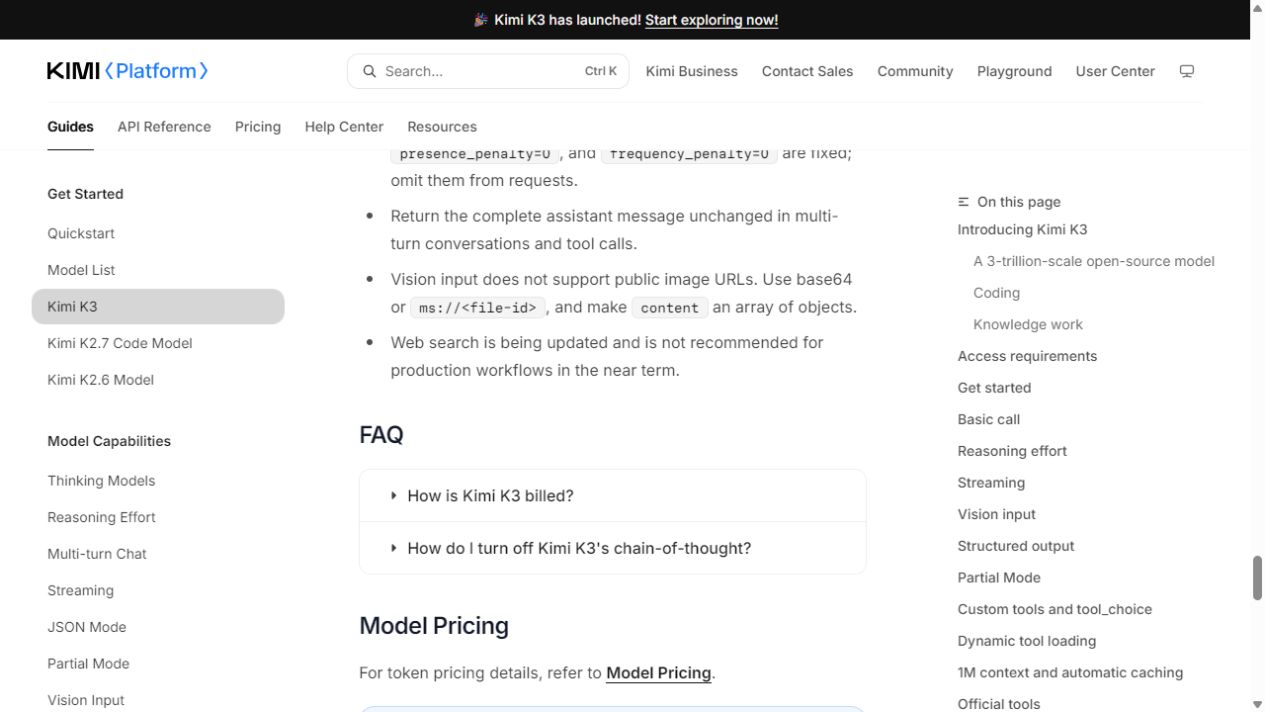
Legacy-model migration: Kimi’s current model list says kimi-k2.5 and the moonshot-v1 series are closed to newly registered users and announces a full platform sunset on August 31, 2026. Existing integrations should migrate before the announced date. New projects should begin with a model that Kimi currently lists for the intended workload, such as kimi-k3 or kimi-k2.7-code, rather than treating a legacy endpoint as durable.
Where Kimi K2.7 Code fits
Kimi K2.7 Code should not replace K3 throughout a general MiniMax-versus-Kimi comparison. Kimi’s model list positions K3 as its flagship option for software engineering, knowledge work and reasoning. The same documentation positions K2.7 Code as a dedicated coding model and recommends its high-speed variant when programming-agent output speed is important.
K2.7 Code lists a 256K context, text/image/video input and thinking mode. Its model page describes a 1T-parameter mixture-of-experts architecture with 32B activated parameters. Those specifications make it a relevant candidate for repository edits, terminal agents and long-running coding tasks. They do not establish that it produces safer patches or fewer regressions than M3 or K3. “Dedicated” describes product specialization, not a measured quality winner.
Coding and agent workflows
MiniMax positions M3 for coding, tool use, structured execution and long-horizon agents. It supports interleaved thinking between tool interactions and offers reasoning modes that let developers trade additional reasoning for throughput. Kimi positions K3 for long-horizon coding and knowledge work, and its API includes tool-choice constraints and dynamic tool loading. K2.7 Code narrows the Kimi choice to a model explicitly designed around coding agents.
Choose the first test according to workflow fit:
- Large mixed repository and design corpus: test M3 and K3 because both advertise million-token context. Do not infer repository recall from that number.
- Terminal-centered software agent: include K2.7 Code because Kimi documents that specialization; include M3 or K3 as the general-model control.
- Agent needing optional non-reasoning responses: M3 documents a disabled reasoning mode, while K3 always reasons on the verification date.
- Dynamic tool catalogs: K3 documents dynamic tool loading. Confirm that the exact API behavior suits your orchestration framework.
- Provider-native media generation: MiniMax has separate official video, speech, music and image APIs. M3 itself analyzes media and returns text; it does not replace those generation models.
For implementation details, use our independently maintained MiniMax API guide alongside the provider documentation. Pin model IDs where the provider offers dated versions, log tool arguments and keep a human approval step before destructive commands, deployments, purchases or changes to production data.
Multimodal work and media generation
M3 and K3 both accept text, images and video in documented API workflows and return text. That supports screenshot analysis, UI feedback, video summarization and visual-to-code tasks. It does not mean either language-model endpoint directly generates a finished video, song or speech track.
MiniMax’s broader platform includes dedicated Hailuo video, speech, music and image models. Kimi’s first-party products emphasize chat, coding, agents, documents, slides, sheets and knowledge work. Select the provider’s dedicated generation endpoint when your output must be media, and separately test the language model that plans or evaluates the workflow.
API pricing: a dated snapshot, not a permanent verdict
The official prices checked on July 18, 2026 are shown per one million tokens and exclude applicable taxes. MiniMax labels its M3 figures as a permanent 50% discount, while Kimi K3 uses flat rates across its context range. Verify the provider page before budgeting; cache eligibility, service tier, retries, reasoning output and region can change the effective bill.
| API model | Cached input / read | Uncached input | Output | Context pricing note |
|---|---|---|---|---|
| MiniMax M3 Standard, input at or below 512K | $0.06 | $0.30 | $1.20 | Per 1M tokens |
| MiniMax M3 Standard, input above 512K | $0.12 | $0.60 | $2.40 | Per 1M tokens |
| Kimi K3 | $0.30 | $3.00 | $15.00 | Flat rate across the listed 1M context |
| Kimi K2.7 Code | $0.19 | $0.95 | $4.00 | 256K context |
On these list prices, M3 costs less per token than K3 and K2.7 Code. That is an objective price-table comparison, not proof of lower project cost. A model that needs more retries, produces longer reasoning output or requires more reviewer corrections may cost more per accepted result. Model memberships and Kimi Code subscriptions are separate products and should not be compared directly with pay-as-you-go API tokens. See our MiniMax pricing guide for the MiniMax billing distinctions.
Open weights, licenses and self-hosting
MiniMax M3 weights are downloadable under the MiniMax Community License; review its commercial, notice, and threshold conditions before deployment. Kimi K3’s full weights are now published under the Kimi K3 License, and Kimi K2.7 Code also has published weights under its stated model license. The original July 18 snapshot predated the K3 weight release; keep that date only as a historical snapshot, not as the current deployment recommendation.
Self-hosting changes the responsibility boundary; it does not guarantee privacy. Your inference server, cloud provider, telemetry, prompts, application logs, plugins, vector database and access controls can still expose data. These large mixture-of-experts models also require substantial hardware and serving expertise. Estimate GPU memory, throughput, failover, monitoring and engineering time before assuming local inference will be cheaper than an API.
Privacy and deployment are separate decisions
| Deployment path | What to verify |
|---|---|
| MiniMax or Kimi consumer app | Consumer privacy policy, account history, file retention, memory, product tools and deletion controls. |
| Hosted provider API | API terms, retention, training use, region, logging, subprocessors, enterprise controls and contract commitments. |
| Self-hosted weights | Model license, infrastructure location, telemetry, application logs, access control, backups, plugins and incident response. |
| Third-party host | The host’s terms and data flow in addition to the model developer’s license. |
Do not treat either provider as having universal zero retention or universal non-training terms across every product. Obtain the applicable enterprise terms before sending source code, credentials, customer records, medical data, legal material or confidential documents. Redact secrets, use least-privilege tools and require approval for consequential agent actions.
The independent chat on this site is another deployment path. Its documented demo features and limits are not MiniMax product capabilities, and it should not be used to infer how MiniMax’s official app or Kimi handles files, models or account data.
A practical evaluation before choosing
- Name exact models: compare
MiniMax-M3andkimi-k3; addkimi-k2.7-codefor a coding-focused arm. - Freeze the task set: use the same repository commit, issue descriptions, files, tool schemas and success criteria.
- Use multiple task types: bug repair, multi-file refactor, test generation, visual-to-code, long-document retrieval and a failed-tool recovery case.
- Test long-context retrieval: plant verifiable facts near the beginning, middle and end. Measure exact recall and citation, not context capacity.
- Score code safety: run tests, type checks and security scans. Count unnecessary edits, regressions and fabricated APIs.
- Score tool use: validate function selection, JSON arguments, missing-field questions and recovery from tool errors.
- Measure operations: record time to first token, total latency, rate-limit errors and throughput under your concurrency.
- Calculate accepted-result cost: include input, cached input, reasoning/output tokens, retries and human review minutes.
- Review data handling: map every prompt, file, tool result and log to its processor and retention rule.
- Run a limited pilot: start with reversible, non-production actions and expand permissions only after the model meets your thresholds.
Which should you test for each use case?
| Use case | Test plan |
|---|---|
| Repository-scale coding | Test M3 and K3 at the same context budget; include K2.7 Code as the specialized coding arm. |
| Fast coding-agent output | Include K2.7 Code HighSpeed, then compare quality-adjusted cost and latency. |
| Long contracts or research corpora | Test M3 and K3. Use position-based retrieval checks; do not choose from the 1M label alone. |
| Image/video understanding | Test M3 and K3 on the same media and rubric. Confirm supported file formats and size limits. |
| Video, speech, music or image generation | Evaluate MiniMax’s dedicated generation models; do not assume the M3 chat endpoint creates those outputs. |
| Local deployment | Compare MiniMax M3, Kimi K3, and Kimi K2.7 Code weights, licenses, hardware requirements, and serving infrastructure. K3’s full weights are now published under the Kimi K3 License. |
FAQ
Is MiniMax AI better than Kimi AI?
There is no defensible universal winner without a controlled workload-specific test. MiniMax M3 has lower listed direct-API token rates in this dated snapshot and selectable reasoning modes; Kimi K3 emphasizes long-horizon coding and knowledge work. Compare exact model IDs, settings, tools, latency, accepted outcomes, and total cost.
Does Kimi K3 support web search?
Kimi documents web search for K3, with its Formula official-tools channel as the recommended route. The current K3 quickstart nevertheless warns that web search is being updated and is not recommended for production workflows in the near term. Treat it as documented but temporarily production-caveated, not unavailable.
Which reasoning-effort settings does Kimi K3 support?
Kimi’s current K3 guide lists low, high, and max for the top-level reasoning_effort field, with max as the default. K3 thinking remains enabled; the setting controls the effort level rather than switching reasoning off.
What is happening to kimi-k2.5 and moonshot-v1?
As checked August 26, Kimi’s official model list says both are closed to newly registered users and announces a full platform sunset on August 31, 2026. Existing integrations should migrate before that announced date and verify the replacement against their own prompts and tools.
Which has the larger documented context window?
Kimi lists 1,048,576 tokens for K3. MiniMax says M3 supports up to one million combined tokens and guarantees at least 512K through its API. Those specifications do not prove equivalent retrieval accuracy or usable latency across the full window, so test long-context behavior directly.
Can MiniMax M3 or Kimi K3 generate video directly?
No. Their language-model APIs can accept documented multimodal inputs and return text or tool-related output; they are not the providers’ video-generation endpoints. MiniMax exposes separate Hailuo video APIs, while Kimi’s language-model comparison should not be confused with a media-generation product.
Can I self-host MiniMax M3 or Kimi K3?
Both providers publish model weights under their own licenses. That makes local deployment possible in principle, but it does not make either model a lightweight laptop install. Review the exact license, checkpoint size, serving framework, accelerator memory, and operational safeguards before deployment.
Final recommendation
Use M3 versus K3 as the primary comparison and K2.7 Code as an additional coding-specialist candidate. M3’s documented differentiators include lower listed API rates and selectable reasoning modes. Both M3 and K3 now publish model weights. K3’s documented differentiators include its 2.8T scale, million-token context, always-on reasoning, dynamic tool loading and product focus on long-horizon coding and knowledge work. K2.7 Code offers a narrower coding focus and a 256K context.
None of those facts declares a quality winner. Run a controlled pilot, score accepted outcomes and select the deployment that meets your cost, privacy, latency and review requirements. Browse other independent MiniMax comparisons only as shortlisting material, not as a substitute for your own evaluation.
Official sources
- MiniMax M3 model page — context guarantee, multimodal positioning and model overview.
- MiniMax text-model documentation — model IDs, context, modalities and API paths.
- MiniMax pay-as-you-go pricing — M3 Standard and Priority rates.
- MiniMax M3 official repository — architecture scale, weights, reasoning modes and deployment frameworks.
- Kimi K3 release article — release date, architecture and provider-reported evaluations.
- Kimi K3 on Hugging Face — official model card, full weights, and Kimi K3 License.
- Official Kimi K3 repository — weight-release, deployment, and license documentation.
- Kimi K3 API guide — context, modalities, reasoning, tools, and model status.
- Kimi web-search guide — built-in
$web_searchworkflow and request structure. - Kimi Formula official-tools guide — the recommended official-tools route for K3.
- Kimi model list — K3, K2.7 Code and K2.6 roles.
- Kimi K3 pricing — cache-hit, input and output rates.
- Kimi K2.7 Code pricing — model rates and 256K context.