

Last verified: August 26, 2026.
Quick answer: For a current hosted comparison, test MiniMax-M3 against Alibaba Cloud’s recommended qwen3.8-max. Both providers document text, image, and video input, text output, tool-oriented workflows, and a context window of about one million tokens. MiniMax M3 has lower currently listed direct API token rates in the compared bands and publishes M3 weights under the MiniMax Community License. Qwen 3.8 offers a broader choice of distinct hosted and downloadable models, but those products do not share one feature set or one license.
Independent-site notice: MiniMax-AI.chat is an independent educational website. It is not MiniMax, Alibaba Cloud, or the Qwen team and is not affiliated with or endorsed by them. Prices, access, model IDs, regions, licenses, and limits are controlled by the providers. This comparison uses official documentation and model cards; it is not a same-prompt performance benchmark.
Bottom line: Choose a deployment path before choosing a winner. Compare M3 with
qwen3.8-maxfor hosted API work. For local deployment, compare M3 weights with an exact Qwen checkpoint such asQwen3.8-2.4T-A95BorQwen3.8-27B. Do not transfer the hosted Max model’s modalities, context defaults, or service features to a downloadable checkpoint, and do not assume every Qwen weight release uses Apache 2.0.
On this page
- Quick comparison
- What is actually being compared?
- Hosted M3 vs qwen3.8-max
- Reasoning controls and API behavior
- Access, regions, and API formats
- API pricing
- Coding, tools, and agents
- Open weights, licenses, and local deployment
- Privacy and data location
- Decision guide
- How to run a fair evaluation
- Important limitations
- Frequently asked questions
- Official sources and update log
MiniMax M3 vs Qwen 3.8: quick comparison
| Question | MiniMax M3 | Qwen 3.8 |
|---|---|---|
| Current hosted model to test | MiniMax-M3 | qwen3.8-max |
| Hosted context | Up to 1,000,000 combined input and output tokens | 1,000,000-token context window |
| Hosted input and output | Text, image, and video input; text output | Text, image, and video input; text output |
| Hosted API formats | Anthropic-compatible and OpenAI-compatible routes | OpenAI-compatible, Anthropic-compatible, and DashScope routes, with region-specific base URLs |
| Current list-price starting point | $0.30/M input and $1.20/M output at Standard service with input at or below 512K | $1.65/M input and $4.951/M output in listed Global-scope regions; $2/$6 in Singapore International scope |
| Downloadable weights | M3 weights under the MiniMax Community License | Model-specific Qwen checkpoints; licenses and capabilities differ |
| Best first test | Cost-sensitive hosted agents, very long multimodal context, or a licensed M3 deployment | Alibaba Cloud-native hosted work or a model-specific Qwen local deployment |
This table compares documented specifications and list prices, not answer quality. A one-million-token label is a capacity limit, not proof that every fact is retrieved accurately across the full context. Tool calls, reasoning output, retries, cache behavior, latency, infrastructure, and human review can change the cost per accepted result.
What is actually being compared?
“MiniMax AI vs Qwen” can describe several different decisions. A hosted API model, a consumer chat product, a coding endpoint, and a downloadable checkpoint are separate products even when they share a company or model-family name.
| Option | What it is | Use it in this comparison for |
|---|---|---|
MiniMax-M3 | MiniMax’s hosted and downloadable native multimodal M-series model | Coding, agents, long context, tool use, and text/image/video understanding |
qwen3.8-max | Alibaba Cloud Model Studio’s current recommended hosted Qwen flagship | Hosted coding, office work, long-horizon agents, multimodal understanding, and Alibaba Cloud integration |
qwen3-coder-next | A separately documented Qwen-Coder endpoint | A supplementary code-focused test when its region and workflow fit; Alibaba recommends testing current general-purpose models first for many scenarios |
Qwen3.8-2.4T-A95B | A downloadable text-only MoE checkpoint with mandatory thinking | Large-scale local text and reasoning workloads after reviewing its custom license and infrastructure needs |
Qwen3.8-27B | A downloadable dense vision-language checkpoint | A smaller local text/image/video-understanding deployment under Apache 2.0 |
Alibaba Cloud still lists Qwen 3.7 Plus and Flash in its current recommended-model page, but qwen3.8-max is the first current Qwen model shown. Qwen 3.7 can remain relevant to an existing integration or a different price target; it should not be presented as the current flagship generation. The previous version of this article centered the comparison on Qwen 3.7 Max and Plus, so its model, pricing, modality, and licensing assumptions cannot be updated safely through a simple name replacement.
Hosted MiniMax M3 vs qwen3.8-max
MiniMax M3
MiniMax M3 is MiniMax’s current M-series language model. Official documentation describes text, image, and video input, text output, tool use, agentic reasoning, and a hosted context window of up to one million tokens. MiniMax publishes the weights and deployment resources separately under the MiniMax Community License.
The hosted context is a combined input-and-output budget. MiniMax recommends a maximum output of 131,072 tokens and documents a higher configurable maximum, but a request cannot use the entire context for input and then add a full maximum-length answer. Read our independent MiniMax M3 guide for model-specific implementation and license notes.
Qwen 3.8 Max
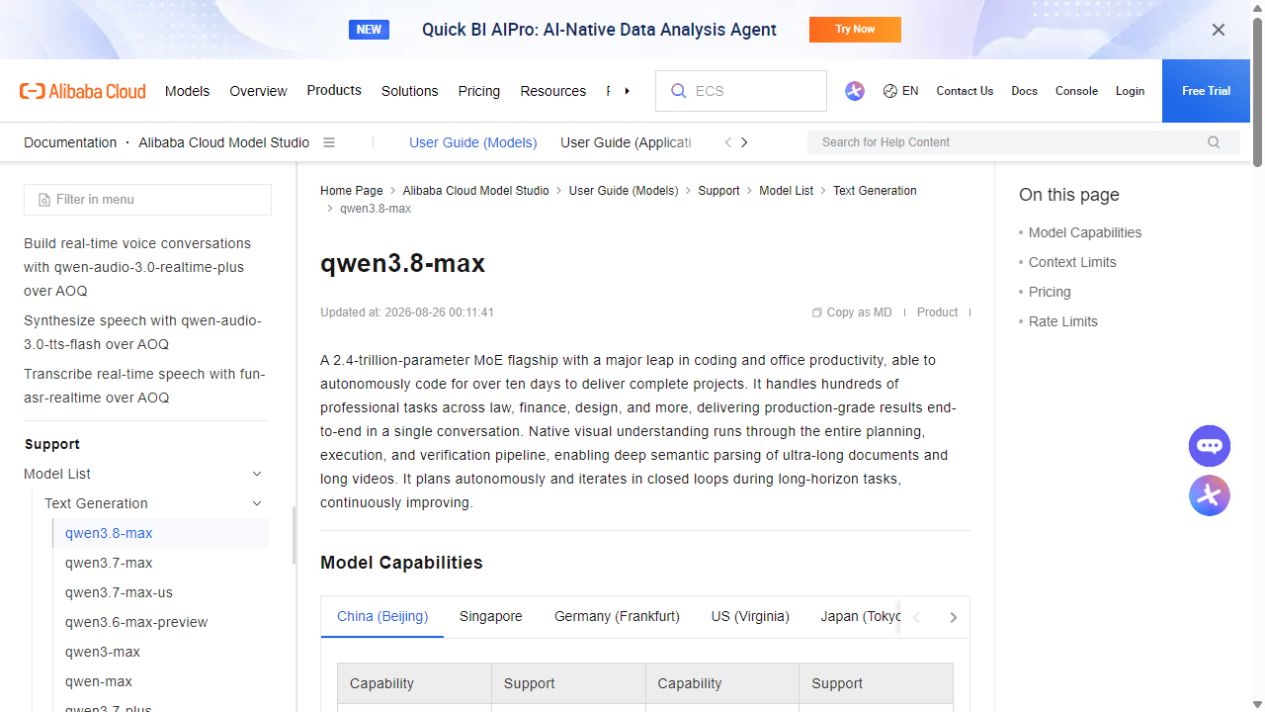
Alibaba Cloud describes qwen3.8-max as a 2.4-trillion-parameter Mixture-of-Experts flagship for coding, office productivity, professional work, and long-horizon tasks. The hosted model accepts text, images, and video, returns text, supports function calling and structured outputs, and lists a 1,000,000-token context window. The current specification gives a maximum input length of 991,808 tokens and a maximum output length of 131,072 tokens.
Built-in web search is region-dependent. On the official page checked August 26, 2026, it is listed as supported in Beijing and Singapore and unsupported in Frankfurt, Virginia, Tokyo, and Hong Kong. Do not copy a feature, base URL, API key, price, or data-location assumption from one Alibaba region to another.
| Hosted-model fact | MiniMax-M3 | qwen3.8-max |
|---|---|---|
| Text input | Yes | Yes |
| Image input | Yes | Yes |
| Video input | Yes | Yes |
| Language-model output | Text | Text |
| Published context | Up to 1M combined input/output; MiniMax also states a guaranteed API minimum of 512K | 1M context; 991,808 maximum input and 131,072 maximum output listed on the current model page |
| Function/tool calling | Supported | Supported |
| Structured output | Use the exact MiniMax endpoint and supported parameter set | Supported on the current hosted model page |
| Server-side web search | web_search is listed separately at $0.01/request | Region-dependent; supported in Beijing and Singapore on the checked model page |
| Media generation | Not through an ordinary M3 text response; MiniMax uses separate video, image, speech, and music models | Not established by the language-model modalities; Alibaba uses separate generation services for image, audio, and video output |
Reasoning controls and API behavior
Reasoning settings should be configured explicitly during a benchmark. Different defaults can change latency, token use, and output even when the user prompt stays the same.
- MiniMax Anthropic-compatible Messages: M3 thinking is off when
thinkingis omitted. Use{"type":"adaptive"}to enable it or{"type":"disabled"}to keep it off. - MiniMax OpenAI-compatible Chat Completions: M3 thinking is on when
thinkingis omitted. The documented values areadaptiveanddisabled. - Hosted Qwen 3.8 Max: Alibaba’s model page lists thinking-related limits and Partial Mode, but integrations should use the parameters documented for the selected regional endpoint rather than importing a setting from a local checkpoint.
- Qwen3.8-2.4T-A95B weights: The official model card says this text-only checkpoint requires thinking and cannot disable it.
- Qwen3.8-27B weights: The official model card says thinking is on by default but can be disabled;
reasoning_effortcontrols depth where the serving framework supports it.
The previous article described M3 as having enabled, adaptive, and disabled modes. That wording was inaccurate. Current MiniMax compatibility documentation names adaptive and disabled, with omission behavior depending on the endpoint.
Access, regions, and API formats
| Access question | MiniMax M3 | Qwen 3.8 Max |
|---|---|---|
| Official console | MiniMax Open Platform | Alibaba Cloud Model Studio |
| OpenAI-compatible base route | https://api.minimax.io/v1 | Region- and workspace-specific /compatible-mode/v1 URL |
| Anthropic-compatible base route | https://api.minimax.io/anthropic | Region- and workspace-specific /apps/anthropic URL |
| Provider-native route | MiniMax standard APIs by product | DashScope route with a region- and workspace-specific base URL |
| Regions shown on current model list | Confirm availability and contractual region in the MiniMax account | Beijing, Hong Kong, Singapore, Tokyo, Frankfurt, and US Virginia |
| Downloadable comparison path | Official M3 weights and deployment repositories | Exact Qwen checkpoint and its own model card |
API-format compatibility does not guarantee identical parameter support. Validate request fields, message roles, image/video encoding, tool schemas, reasoning fields, streaming events, token accounting, and error responses against the exact endpoint being deployed.
MiniMax M3 vs Qwen 3.8 Max API pricing
The following USD list prices were checked in the providers’ official documentation on August 26, 2026. They exclude taxes, temporary promotions, third-party hosting, tools, retries, and human review. Alibaba explicitly says its model page displays original pricing and directs users to the console for promotions.
| Model and scope | Input / 1M tokens | Output / 1M tokens | Cache and tier note |
|---|---|---|---|
| MiniMax M3 Standard, input ≤512K | $0.30 | $1.20 | Prompt-cache read $0.06/M |
| MiniMax M3 Standard, input >512K | $0.60 | $2.40 | Prompt-cache read $0.12/M; the higher band applies after the input threshold is crossed |
| MiniMax M3 Priority, input ≤512K | $0.45 | $1.80 | Prompt-cache read $0.09/M; Priority is 1.5× Standard |
| MiniMax M3 Priority, input >512K | $0.90 | $3.60 | Prompt-cache read $0.18/M |
| Qwen 3.8 Max, listed Global scope | $1.65 | $4.951 | Implicit-cache input $0.206/M; explicit-cache creation $2.063/M; explicit-cache read $0.137/M |
| Qwen 3.8 Max, Singapore International scope | $2.00 | $6.00 | Implicit-cache input $0.25/M; explicit-cache creation $2.50/M; explicit-cache read $0.17/M |
Alibaba lists the Global-scope row for Beijing, Frankfurt, Virginia, Tokyo, and Hong Kong on the model page checked; Singapore uses the International-scope row. In these direct list-price rows, M3 is cheaper per ordinary input and output token. That does not prove a lower completed-task cost: Qwen or M3 may use different amounts of reasoning, output, caching, tool calls, retries, or reviewer time.
Illustrative cost example
For a hypothetical request with 200,000 uncached input tokens and 20,000 output tokens, before tools or taxes:
MiniMax M3 Standard:
0.20 × $0.30 + 0.02 × $1.20 = $0.084

Qwen 3.8 Max, listed Global scope:
0.20 × $1.65 + 0.02 × $4.951 = $0.42902
This is arithmetic from list prices, not an observed invoice or a quality result. Compare the same accepted deliverable and log actual usage.
Coding, tools, and agent workflows
Both hosted models are positioned for coding and agentic work. The model alone does not read a repository, execute tests, browse the web, or edit production systems. Those actions require a harness that exposes tools, manages credentials and permissions, records changes, and validates results.
For a current hosted coding evaluation, use MiniMax-M3 and qwen3.8-max as the main two arms. Add qwen3-coder-next only when its specialized endpoint and regional availability fit the intended deployment. Alibaba’s current Qwen-Coder documentation explicitly recommends the latest general-purpose models for many scenarios.
- Use the same repository commit, issue description, tool definitions, timeout, and acceptance tests.
- Record the exact model ID, region, endpoint, reasoning setting, service tier, and date.
- Count tests passed, regressions, fabricated dependencies, malformed tool arguments, unauthorized changes, retries, and reviewer corrections.
- Require human approval before deletion, production writes, credential use, purchases, or external messages.
- Compare cost per accepted patch, not price per million tokens alone.
Open weights, licenses, and local deployment
“Open weight” does not define one license or one deployment difficulty. Check the exact model card attached to the files. A repository-level license or a hosted product description should not replace the model-specific license.
| Downloadable model | Documented architecture and modalities | Context behavior | Published license |
|---|---|---|---|
| MiniMax M3 | Approximately 428B total parameters and 23B activated; native text, image, and video input | Up to 1M in the official model materials; deployment support depends on runtime and hardware | MiniMax Community License with commercial-use conditions |
| Qwen3.8-2.4T-A95B | 2.4T total parameters and 95B activated; the downloadable checkpoint is text-only and requires thinking | 262,144 native tokens, extensible to 1,010,000 according to the official model card | qwen3.8-max custom license |
| Qwen3.8-27B | 27B dense model with native image and video understanding; thinking can be disabled | 262,144 native tokens, extensible to 1,000,000 with the documented long-context configuration | Apache 2.0 |
The official Qwen3.8-2.4T-A95B card is especially important: it labels the checkpoint text-only, requires thinking for every interaction, and displays a custom qwen3.8-max license. Those facts differ from hosted qwen3.8-max, which adds native visual input, a one-million-token service context, separate thinking-mode limits, and built-in platform features. Do not describe the 2.4T checkpoint as Apache 2.0 or as a drop-in local copy of every hosted capability.
Qwen3.8-27B is a separate, smaller checkpoint. Its official model card displays Apache 2.0, native vision-language support, thinking and non-thinking modes, and a 262,144-token native context that can be extended toward one million through the documented serving configuration. Extension is not the same as a native one-million-token default, and the model card warns that static scaling can affect shorter inputs.
M3 and the 2.4T Qwen checkpoint are data-center-scale deployments. Even the 27B model requires realistic GPU-memory, vision, context-cache, throughput, quantization, security, and operations planning. “Runs locally” should not be translated into “runs well on a normal laptop.”
Privacy, data location, and governance
| Deployment path | What to verify |
|---|---|
| MiniMax hosted API | Applicable API terms, retention, training use, processing region, subprocessors, access controls, logs, and enterprise agreement |
| Alibaba Cloud Model Studio | Selected region and scope, workspace configuration, service terms, retention, logging, web-search data flow, and contractual controls |
| Self-hosted M3 or Qwen checkpoint | Exact model license, cloud or hardware location, telemetry, application logs, vector stores, backups, plugins, network controls, and operator access |
| Third-party inference host | The host’s data practices and terms in addition to the model-card license |
Open weights do not automatically make an application private. Prompts can still enter logs, monitoring systems, storage, retrieval databases, backups, and external tools. Hosted access does not establish universal zero retention. Obtain the applicable terms before processing credentials, unreleased code, customer data, medical records, legal files, or other regulated information.
Which should you test first?
| Requirement | Better first test | Reason |
|---|---|---|
| Lowest listed hosted token rate in this comparison | MiniMax M3 | Its current Standard rows are lower than the checked qwen3.8-max regional rows |
| Alibaba Cloud-native architecture | qwen3.8-max | It is the current recommended Qwen model across documented regional Model Studio routes |
| Hosted million-token multimodal work | Both | Both document about one million tokens and text/image/video input; benchmark retrieval and total workflow cost |
| Download the same M3 family being evaluated | MiniMax M3 weights | Official weights are available, subject to the MiniMax Community License and substantial infrastructure needs |
| Apache 2.0 local vision-language model | Qwen3.8-27B | The official model card displays Apache 2.0 and native image/video understanding |
| Largest Qwen open-weight flagship-scale text model | Qwen3.8-2.4T-A95B | It publishes 2.4T/95B-activated weights, but it is text-only, requires thinking, and uses a custom license |
| Specialized Qwen coding endpoint | qwen3-coder-next as an additional arm | It remains documented, but Alibaba recommends current general-purpose models for many scenarios |
| Sensitive or regulated work | Contract- and deployment-dependent | Compare exact data terms, region, retention, controls, and self-hosting operations |
How to run a fair MiniMax vs Qwen evaluation
- Choose exact products. Record the model ID, hosted region or checkpoint revision, endpoint, and date.
- Freeze the inputs. Use the same repository commit, documents, images, videos, tools, and system instructions.
- Match reasoning deliberately. Do not rely on endpoint defaults; document the supported setting used for each model.
- Define acceptance first. Set objective rules for code tests, retrieval citations, schema validity, tool actions, and prohibited behavior.
- Test long context. Place known facts near the beginning, middle, and end, then score exact retrieval and unsupported answers.
- Include failures. Record rate limits, malformed calls, tool timeouts, retries, unauthorized changes, and incomplete recovery.
- Measure operations. Track latency, throughput, context size, input/output/cache tokens, tool calls, infrastructure, and reviewer minutes.
- Repeat tasks. One polished response cannot establish reliability.
- Review licensing and privacy. Match the exact service or checkpoint to the intended commercial and data-processing use.
- Select by accepted outcome. Use completion rate and total cost per approved result, not vendor benchmark rank alone.
Important limitations
- This page did not run a controlled MiniMax M3 vs Qwen 3.8 benchmark.
- Provider benchmark results are not treated as neutral proof of an overall winner.
- Context capacity does not prove equal retrieval quality at every position.
- Hosted model features do not automatically exist in downloadable checkpoints.
- A company repository’s license does not replace the exact model-card license.
- Qwen prices, URLs, web-search support, and data location vary by region and scope.
- MiniMax M3 changes price after its documented 512K input threshold.
- API compatibility does not guarantee identical parameters or response formats.
- Local deployment adds infrastructure, security, monitoring, and upgrade costs.
- All model-generated code, facts, and tool actions require verification.
MiniMax AI vs Qwen FAQ
Is MiniMax AI better than Qwen?
Not universally. MiniMax M3 is the stronger first test when its lower listed hosted rates, M3-compatible agent stack, or downloadable M3 weights matter. Qwen is the stronger first test for an Alibaba Cloud-native workflow or when a specific Qwen 3.8 checkpoint and license better fit local deployment. Test the exact products on the same tasks.
Which Qwen model should be compared with MiniMax M3?
For a current hosted comparison, start with qwen3.8-max. For local deployment, select an exact checkpoint such as Qwen3.8-2.4T-A95B or Qwen3.8-27B. Do not call a downloadable checkpoint the same product as hosted Max.
Do MiniMax M3 and Qwen 3.8 support one million tokens?
The hosted M3 and qwen3.8-max documentation both list about a one-million-token context. The downloadable Qwen3.8-2.4T-A95B and Qwen3.8-27B cards list 262,144 native tokens with documented extension toward one million. A context limit is not a retrieval-quality score, and local extension can involve runtime-specific trade-offs.
Are all Qwen models Apache 2.0?
No. The official Qwen3.8-27B model card displays Apache 2.0, while the Qwen3.8-2.4T-A95B card displays the custom qwen3.8-max license. Hosted qwen3.8-max is governed by Alibaba Cloud service terms rather than a downloadable-checkpoint license. Always inspect the exact model card and license file.
Which has lower API pricing?
MiniMax M3 has lower direct list prices than the checked qwen3.8-max regional rows. M3 Standard starts at $0.30/M input and $1.20/M output at or below 512K input, while qwen3.8-max is listed at $1.65/$4.951 in Global scope and $2/$6 in Singapore International scope. Compare cache charges, reasoning, retries, tools, promotions, and accepted-task cost before choosing.
Can MiniMax M3 and Qwen run locally?
Selected weights can. MiniMax publishes M3 weights under its Community License. Qwen publishes model-specific checkpoints including Qwen3.8-2.4T-A95B and Qwen3.8-27B under different licenses. Hardware and operations requirements vary greatly, and the largest checkpoints are not normal laptop deployments.
Are MiniMax M3 and every Qwen 3.8 checkpoint multimodal?
No. Hosted M3, hosted qwen3.8-max, and Qwen3.8-27B accept visual input according to their official documentation. The downloadable Qwen3.8-2.4T-A95B card explicitly describes that checkpoint as text-only. Check the exact runtime as well as the model card because some local serving paths may not implement every modality.
Can I test the full provider models on MiniMax-AI.chat?
No. This site’s independent demo is not the complete MiniMax Open Platform, Alibaba Cloud Model Studio, MiniMax Agent, MiniMax Code, Qwen consumer product, or Qwen local deployment. Do not use it to infer the providers’ current model version, context window, file handling, multimodal support, quotas, privacy controls, or enterprise features.
Official sources
- MiniMax model catalog
- MiniMax Pay as You Go pricing
- MiniMax Anthropic-compatible API
- MiniMax OpenAI-compatible API
- Official MiniMax M3 model card
- Alibaba Cloud Model Studio recommended models and regional routes
- Official qwen3.8-max capabilities, context, regional features, prices, and limits
- Alibaba Cloud model lifecycle and release log
- Official Qwen-Coder documentation
- Official Qwen 3.8 repository
- Official Qwen3.8-2.4T-A95B model card and license label
- Official Qwen3.8-27B model card and Apache 2.0 label
Update log
- August 26, 2026: Rebuilt the comparison around hosted
qwen3.8-max; separated hosted products from Qwen3.8-2.4T-A95B and Qwen3.8-27B checkpoints; corrected M3 reasoning controls; replaced Qwen 3.7 pricing with current Qwen 3.8 regional pricing; added visible FAQ answers and model-specific licensing cautions.