

Last verified: September 24, 2026
MiniMax H3 Max is the speed-focused sibling of MiniMax H3. MiniMax’s own video guide describes it as a model “jointly released by MiniMax and fal.ai,” post-trained by fal.ai on top of MiniMax H3 and optimized for high-speed generation. It is billed per generated second on MiniMax’s Pay-as-you-go API: $0.05 per second at 480P and $0.08 per second at 768P. It does not output 2K, and its shortest clip is 5 seconds rather than H3’s 4.
That makes H3 Max the cheaper and quicker option for drafts, social cuts, and anything where you want many takes before you commit. It is not automatically the cheaper option for every job, though. Its reference-material fees are higher than H3’s, so a reference-heavy 768P request can cost more on H3 Max than on H3. The sections below show where that line falls, with the arithmetic written out.
- API model name:
MiniMax-H3-Max, called through the same Video Generation V2 endpoint as H3. - Output: 480P or 768P (768P is the default), 5–15 seconds in whole seconds, 24 fps.
- Modes: text-to-video, image-to-video with a first frame, last frame, or both, and reference generation.
- Billing: Pay-as-you-go API only on the MiniMax platform. There is no official free API allowance.
- Where else it appears: inside MiniMax Design, and on third-party hosts such as fal, which runs its own free daily allowance.
MiniMax-AI.chat is an independent guide. We are not MiniMax or fal, we do not sell access to either service, and we have not run a paid H3 Max benchmark. Speed and quality statements below are attributed to whoever made them.
H3 Max vs H3: the specifications side by side
Both models live in the “Video” section of MiniMax’s official model catalog, both use POST https://api.minimax.io/v2/video_generation, and you switch between them with the model field. Everything else in this table comes from MiniMax’s video guide, API reference, and Pay-as-you-go price list as they read on September 24, 2026.
| Item | MiniMax H3 Max | MiniMax H3 |
|---|---|---|
| API model name | MiniMax-H3-Max | MiniMax-H3 |
| Who made it | Post-trained by fal.ai on MiniMax H3; jointly released by MiniMax and fal.ai | MiniMax |
| Design goal | High-speed generation at mainstream resolutions | General-purpose multimodal generation, editing, and hosted 2K |
| Output resolution | 480P or 768P; 2K is not supported | 768P or 2K |
| Output duration | 5–15 seconds, integers only (4 seconds is not accepted) | 4–15 seconds, integers only |
| Frame rate (catalog) | 24 fps | 24 fps |
| Generation modes | Text-to-video, image-to-video (first/last frame), reference generation | Text-to-video, image-to-video (first/last frame), reference generation |
| Extra API option | extra.prompt_expansion_mode: disabled, balanced (default), or quality | Not offered |
| 768P-to-2K regeneration | Not documented for H3 Max | Yes, via the Video Regeneration task |
| Output price | $0.05/s at 480P; $0.08/s at 768P | $0.08/s at 768P; $0.13/s at 2K |
| Reference images | First 2 free, then $0.074 per additional image | First 5 free, then $0.04 per additional image |
| Input video | $0.0553/s for 480P output; $0.143/s for 768P output | $0.08/s for 768P output; $0.13/s for 2K output |
| Input audio | Free | Free |
| Billing route | Pay-as-you-go API only | Pay-as-you-go API only |
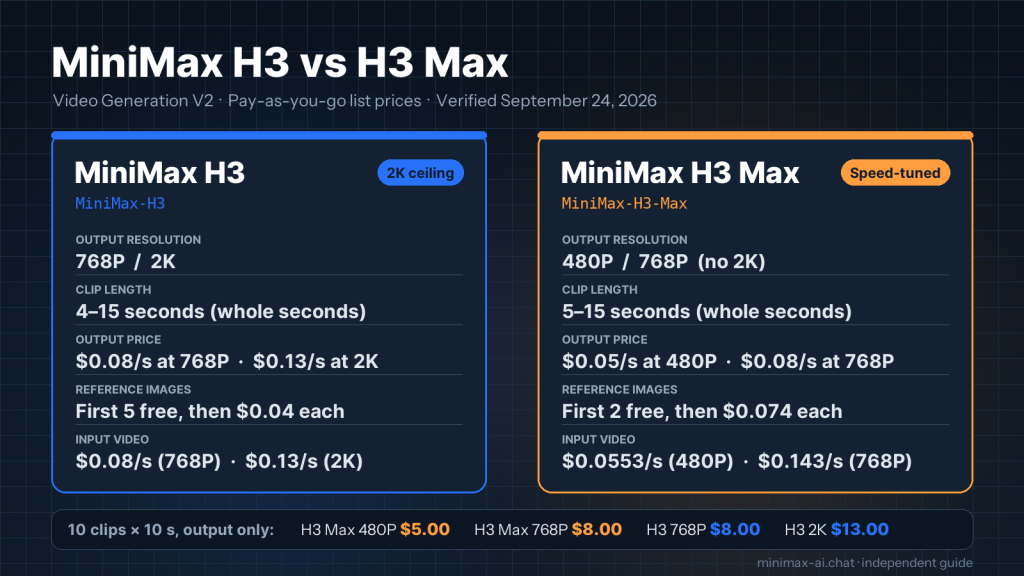
One small inconsistency is worth knowing about. MiniMax’s model catalog summarizes H3 Max as text-to-video and image-to-video, while the video guide and the API reference both list reference generation as a supported H3 Max mode, with reference images, videos, and audio. We follow the API reference, because that is the document your request is validated against, but a quick test call is the safest way to confirm a mode before you build around it.
Who built H3 Max, and what “post-trained by fal” means
H3 Max did not start from scratch. MiniMax released H3 on July 31, 2026, and followed it with open H3-Base weights in early August. fal, a generative-media inference company, took those open weights and continued training them. In fal’s words, the team “introduced substantial new data during post-training, with a particular focus on prompt adherence and visual quality,” and designed the serving stack around its own inference engine at the same time.
MiniMax treats the result as one of its two current video models. Its video guide says it “currently offers two video generation models — MiniMax H3 and MiniMax H3 Max,” and it lists H3 Max as a selectable value in its own API. So H3 Max is not merely a community fork: it is served on MiniMax’s platform, priced by MiniMax, and offered inside MiniMax Design.
On timing, fal’s announcement post, “Introducing H3 Max by fal,” is dated August 27, 2026 and says the model was “available today on fal.” MiniMax’s model release-notes page did not have a dated H3 Max entry when we checked on September 24, and the main navigation on minimax.io still lists only H3 under Video. The most accurate summary is that H3 Max launched in late August 2026, with fal’s post as the dated primary source.
Keep the claims separate. fal says H3 Max ranks first on overall quality, prompt understanding, and aesthetics in its own human-preference studies, and cites first-place positions on the Design Arena and Artificial Analysis image-to-video boards. Those are fal’s statements about fal’s evaluations and third-party leaderboards. MiniMax’s documentation makes a narrower claim: H3 Max “generates faster than MiniMax H3.”
What actually changes when you switch from H3 to H3 Max
From a developer’s point of view, moving a request from H3 to H3 Max is a one-word change to the model field, plus a check that your resolution and duration are still valid. The practical differences show up in five places.
1. The resolution ceiling drops to 768P
H3 Max accepts 480P and 768P. If you send 2K, the request is invalid; the API reference states plainly that 2K “is not supported” for this model. There is also no documented path to regenerate an H3 Max clip at 2K. MiniMax’s Video Regeneration task is described as accepting a source video “that meets the MiniMax-H3 768P output specifications,” so treat 2K as an H3-only feature.
480P is new territory for the H3 family. H3 itself has no 480P option, so H3 Max is the only way on MiniMax’s V2 API to buy a lower-resolution, lower-cost preview.
2. Generation is faster, and the size of that difference depends on who is measuring
Speed is the whole point of the model, but the published figures come from three different sources and measure different things:
| Source | What it says | What it measures |
|---|---|---|
| MiniMax API documentation | H3 Max “generates faster than MiniMax H3” | No number is published |
| MiniMax Design (official MiniMax product) | About 15 seconds for a 5-second video; about 40 seconds for a 15-second video | Time inside the Design app; MiniMax notes that it varies with settings and service conditions |
| fal (third party) | A 5-second 768p clip in under 3 seconds end to end; 2.46 s of inference for 5 s at 768p and 15.17 s for 15 s at 768p, measured September 8, 2026 | fal’s own endpoint; the per-clip figures are the model’s reported inference time, which excludes queue wait, prompt expansion, and encoding |
None of these is a promise about MiniMax’s API queue on a busy afternoon. If latency matters to your product, time your own requests from submission to a succeeded status and keep the distribution, not just the best case.
3. The duration window starts at 5 seconds
H3 accepts 4–15 seconds. H3 Max accepts 5–15 seconds, and the API reference specifically says 4 seconds is not supported. That matters if you have H3 code that requests 4-second clips for bumpers or loops: switching the model name alone will produce a parameter error. It also sets the cheapest possible H3 Max clip at 5 × $0.05 = $0.25 at 480P, compared with 4 × $0.08 = $0.32 for the shortest H3 clip.
4. Input limits are shared, but input fees are not
MiniMax publishes one set of input requirements for both video models. Every request needs a non-empty text item, and image-to-video and reference generation cannot be mixed in the same request.
| Input | Official limit (both models) |
|---|---|
| Prompt | Up to 7,000 characters; one text item is required |
| First/last-frame images | 0, 1, or 2 images; width and height 256–5,760 px; aspect ratio 0.4–2.5 |
| Reference images | Up to 9; JPG, JPEG, PNG, WEBP, HEIC, or HEIF; 30 MB each |
| Reference videos | Up to 3 MP4 or MOV clips (H.264 or H.265; AAC or MP3 audio); 2–15 s each, 15 s total; 50 MB each; 23.976–60 fps |
| Reference audio | Up to 3 WAV or MP3 clips; 2–15 s each, 15 s total; 15 MB each |
| Mixed references | 12 files in total |
| Request body | 64 MB; MiniMax recommends public URLs over Base64 for large files |
The fees attached to those inputs are where the two models part ways. H3 Max includes two free images per request instead of five, charges $0.074 for each extra image instead of $0.04, and bills input video at $0.143 per second when you generate at 768P, which is more than the $0.08 H3 charges at the same output resolution. Audio references are free on both.
5. Output is cheaper; reference-heavy work may not be
At 768P the output rate is identical: $0.08 per second on both models. The savings come from dropping to 480P, where H3 Max costs $0.05 per second. For plain text-to-video and simple image-to-video, H3 Max is therefore the same price or cheaper. For a 768P request that carries several reference images or a reference video, H3 Max can be the more expensive choice. The worked examples below make that concrete.
MiniMax H3 Max pricing, line by line
These are the list prices on MiniMax’s official Pay-as-you-go page. They are in US dollars and exclude tax, currency conversion, and any contract-specific discount.
Output pricing
| Model | Resolution | Billing rule | List price |
|---|---|---|---|
MiniMax-H3-Max | 480P | Per generated second | $0.05 / second |
MiniMax-H3-Max | 768P | Per generated second | $0.08 / second |
Input-material pricing
| Material | H3 Max billing rule |
|---|---|
| Audio | Free |
| Images | First 2 images free; $0.074 per additional image |
| Video | Billed by input-video duration at the output resolution: $0.0553 / second for 480P, $0.143 / second for 768P |
A few billing details are easy to miss:
- Pay-as-you-go only. MiniMax’s video guide and API reference both say that to use H3 or H3 Max you must select the Pay-as-you-go API. A Token Plan subscription key is not the route for this model.
- Input video follows the output resolution. The same 6-second reference clip costs $0.33 if you render at 480P and $0.86 if you render at 768P.
- The query response shows usage. A finished task reports
output_seconds,input_seconds, andinput_image_count, which you can reconcile against your invoice. - Third-party prices are separate. fal, and any other host that carries H3 Max, sets its own rates. They are covered further down and are not MiniMax prices.
For every other MiniMax rate, from M3 tokens to speech and speech recognition, see our dated MiniMax pricing guide.
What H3 Max costs in practice: worked examples
Every example uses MiniMax’s list prices above, with the formula seconds × per-second rate for output, plus any billable inputs. Failed tasks, retries, and taxes are left out.
Ten 10-second text-to-video clips
| Model and resolution | Calculation | Total |
|---|---|---|
| H3 Max at 480P | 10 clips × 10 s × $0.05 | $5.00 |
| H3 Max at 768P | 10 clips × 10 s × $0.08 | $8.00 |
| H3 at 768P | 10 clips × 10 s × $0.08 | $8.00 |
| H3 at 2K | 10 clips × 10 s × $0.13 | $13.00 |
With no reference media, a 768P batch costs the same on either model. The only way H3 Max saves money here is by rendering at 480P, which cuts the bill by 37.5%.
An image-to-video shot with first and last frames
An 8-second clip that interpolates between an opening and a closing image uses two images, which H3 Max includes for free:
480P: 8 s × $0.05 = $0.40   (2 images: free)
768P: 8 s × $0.08 = $0.64   (2 images: free)
A reference-heavy 15-second shot
Now take a 15-second reference generation with four character images, one 6-second motion-reference video, and one audio track. This is where the input fees change the answer:
| Line item | H3 Max at 480P | H3 Max at 768P | H3 at 768P |
|---|---|---|---|
| Output (15 s) | $0.75 | $1.20 | $1.20 |
| Images (4) | 2 × $0.074 = $0.148 | 2 × $0.074 = $0.148 | $0.00 (5 free) |
| Reference video (6 s) | 6 × $0.0553 = $0.3318 | 6 × $0.143 = $0.858 | 6 × $0.08 = $0.48 |
| Audio | $0.00 | $0.00 | $0.00 |
| Total | about $1.23 | about $2.21 | $1.68 |
At 768P, the H3 Max request costs about 31% more than the same request on H3. If your workflow leans on multiple reference images or motion-reference video, price it on both models before you standardize.
A draft-then-final workflow
A common pattern is to explore cheaply and render the keeper at full quality. Twenty 5-second text-to-video drafts at 480P on H3 Max, followed by three 10-second finals on H3 at 2K:
Drafts: 20 × 5 s × $0.05 = $5.00
Finals:  3 × 10 s × $0.13 = $3.90
Total:                      $8.90
H3 Max and H3 are separate models, so a final render on H3 will not reproduce an H3 Max draft frame for frame. Treat the drafts as a way to settle the prompt, camera move, and timing, not as a preview of the exact final output.
Where you can use MiniMax H3 Max
| Route | Operator | Best for | Billing |
|---|---|---|---|
| MiniMax Video Generation V2 API | MiniMax (official) | Apps, pipelines, and batch jobs | MiniMax Pay-as-you-go wallet and API key |
| MiniMax Design | MiniMax (official) | Creators who want a canvas and agent workflow instead of code | MiniMax Design’s own plans and credits |
| fal | fal (third party) | Developers already on fal, and people who want fal’s free daily generations | fal account and fal’s own prices |
Route 1: the MiniMax Pay-as-you-go API (V2)
H3 Max uses the same asynchronous flow as H3. You create a task, poll GET /v2/query/video_generation/{task_id} (MiniMax suggests roughly every 10 seconds) or register a callback URL, and download the file from content.url when the status is succeeded. The request below is our own example written against the official schema. It has not been run as a paid test by this site.
curl --request POST \
  --url https://api.minimax.io/v2/video_generation \
  --header "Authorization: Bearer $MINIMAX_API_KEY" \
  --header "Content-Type: application/json" \
  --data '{
    "model": "MiniMax-H3-Max",
    "content": [
      {
        "type": "text",
        "text": "Handheld street-level shot of a cyclist weaving through a rainy night market, neon reflections on wet asphalt, steam rising from food stalls. Keep the rider centered as the camera tracks alongside."
      }
    ],
    "resolution": "480P",
    "duration": 6,
    "ratio": "16:9",
    "extra": { "prompt_expansion_mode": "balanced" }
}'- Text-to-video needs an explicit ratio. Use
21:9,16:9,4:3,1:1,3:4, or9:16;adaptiveis rejected when the request contains only text. - Image-to-video follows the image. With a
first_frameorlast_frameimage, the ratio is always treated as adaptive. - Prompt expansion is H3 Max only.
extra.prompt_expansion_modeacceptsdisabled,balanced, orquality, withbalancedas the default. MiniMax warns against passingbalance, an empty string, a Boolean, or any undeclared field. - Rate limits are not yet listed. MiniMax’s rate-limit page showed a row for
MiniMax-H3but none for H3 Max on September 24, 2026. Plan for 429 responses and back off.
Keep the API key on your server, never in browser code. For authentication, error handling, and account setup, see our independent MiniMax API guide.
Route 2: MiniMax Design
MiniMax Design is MiniMax’s agent-driven creative studio. Its H3 Max page says the model is “available directly in MiniMax Design” for text-to-video, image-to-video, and first-and-last-frame control. Design runs as a desktop app for macOS 13 or later (Apple silicon and Intel) and for 64-bit Windows 10 or later. Design has its own membership and credit system. We did not find an H3 Max price in Design credits, so check the in-app cost before a large batch rather than applying the API rates above.
If you are comparing creator tools rather than APIs, our Hailuo AI hub explains how Hailuo Video, MiniMax Design, and the older Hailuo models fit together.
Route 3: fal and other third-party hosts
fal is a third-party service, not MiniMax. Its account, terms, prices, content rules, and support are separate. Everything in this subsection is fal’s claim as published on its H3 Max page and announcement post.
- Extra resolution on fal: fal lists H3 Max at 480p, 768p, and 1080p. The 1080p option is a fal offering; MiniMax’s own API tops out at 768P.
- fal’s list prices: $0.05 per second at 480p, $0.08 at 768p, and $0.16 at 1080p. fal says its 75% launch discount ended on September 14, 2026.
- A “Turbo” variant: fal also sells H3 Max Turbo at half the H3 Max price at each resolution. Turbo is not a MiniMax API model name.
- Endpoints: fal publishes separate text-to-video, image-to-video, and reference-to-video endpoints, each with its own pricing details on its model page.
- Native audio: fal says every H3 Max generation returns synchronized audio. MiniMax’s H3 Max specification table does not list audio separately, so confirm this on the route you actually use.
Other aggregators may list H3 Max under different names. Before paying, confirm who operates the endpoint, which resolution and duration it actually serves, and whether its “H3 Max” is the same model MiniMax documents.
Is MiniMax H3 Max free?
On MiniMax’s own API, no. H3 Max is Pay-as-you-go only, and every generated second is billed at the rates above. MiniMax did not publish a free H3 Max quota on the pages we checked.
The free option people find in search is fal’s. According to fal, signed-in users get five free H3 Max generations a day in the fal sandbox, each up to 15 seconds long, at 768p, on a rolling 24-hour reset, with no subscription required. That allowance belongs to fal. It is not a MiniMax offer, it can change at fal’s discretion, and output beyond it is billed at fal’s prices.
MiniMax’s current promotion for new users points to H3 rather than H3 Max: MiniMax’s documentation and the Hailuo H3 page advertise three free H3 trials when you download MiniMax Design. Whether those trials can be spent on H3 Max is not stated, so treat it as unconfirmed.
The free short-text demo on our homepage is a text chat, not a video generator. It cannot run H3 or H3 Max.
H3 or H3 Max? Pick by the job, not the name
The “Max” suffix suggests a bigger model, but here it means faster rather than more capable. Use this as a starting point:
| If you need… | Choose | Why |
|---|---|---|
| 2K delivery files | H3 | H3 Max stops at 768P, and 2K regeneration is documented only for H3. |
| Lots of cheap drafts or A/B variants | H3 Max at 480P | $0.05 per second is the lowest V2 rate MiniMax publishes. |
| Short turnaround in an interactive tool | H3 Max | Speed is its stated design goal; measure it on your own route. |
| 4-second clips | H3 | H3 Max’s minimum is 5 seconds. |
| Many reference images or motion-reference video at 768P | Price both; often H3 | H3 includes five free images and charges less for input video at 768P. |
| Plain text-to-video at 768P | Either | Output price is identical; choose on speed and output quality. |
| Local or self-hosted generation | H3-Base (open weights) | MiniMax’s hosted H3 Max is an API model. H3-Base is the open-weight option, under its own license. |
For the full H3 picture, including open weights, native stereo audio, and the Community License, read the MiniMax H3 guide. To see where both models sit in the wider lineup, browse the MiniMax models directory.
Limitations and responsible use
What H3 Max will not do
- No 2K and no official 1080P on MiniMax. The MiniMax API caps H3 Max at 768P.
- No clips shorter than 5 seconds or longer than 15. Longer pieces need editing or several shots.
- No Token Plan route. MiniMax requires the Pay-as-you-go API.
- No independent quality verdict yet. fal’s first-place rankings are fal’s reporting. We have not run a controlled H3 versus H3 Max test with matched prompts.
- Documentation is still settling. The catalog, video guide, and API reference describe H3 Max’s modes slightly differently, and the release-notes and rate-limit pages had no H3 Max entry when checked.
Check every clip before you publish it
Fast generation makes it tempting to publish the first acceptable take. Watch the whole clip at full size and listen with headphones if it has sound. Look for drifting faces, extra or missing fingers, text that changes between frames, products whose logo or color shifts, and background details that should not be there. A 480P draft can hide artifacts that become obvious at 768P.
Rights, consent, and disclosure
- Upload only images, video, and audio you own or are licensed to use.
- Get consent before animating a real, identifiable person or cloning their voice.
- Do not create impersonation, fraud, harassment, sexual content involving real people, fake evidence, or misleading news footage.
- Label AI-generated video where the law, the platform, or the context calls for it.
- Read the terms of the route you use. MiniMax’s Open Platform terms, MiniMax Design’s terms, and fal’s terms are separate agreements.
The V2 API documents a 422 error (“video description contains sensitive content”) for flagged requests. Build moderation handling into your pipeline and fix the prompt or input rather than retrying blindly.
MiniMax H3 Max questions, answered
How much does MiniMax H3 Max cost?
On MiniMax’s Pay-as-you-go API, $0.05 per generated second at 480P and $0.08 per second at 768P. Audio inputs are free, the first two images are free and extra images cost $0.074 each, and input video costs $0.0553 per second at 480P or $0.143 per second at 768P.
What is the price of a 10-second H3 Max video?
$0.50 at 480P or $0.80 at 768P for the output alone. Add any billable images or input video on top.
Is H3 Max better than H3?
It is faster and offers a cheaper 480P tier, while H3 offers 2K, 4-second clips, 2K regeneration, and cheaper reference inputs. fal reports that H3 Max beats H3 in its own preference studies, but that is fal’s evaluation. Choose by resolution, budget, and turnaround.
Can I get MiniMax H3 Max for free?
Not on MiniMax’s API. fal says signed-in users of its sandbox get five free H3 Max generations a day of up to 15 seconds each; that is fal’s offer and fal’s terms apply.
Does H3 Max support 2K or 1080P?
MiniMax’s API supports only 480P and 768P for H3 Max and rejects 2K. fal offers a 1080p option on its own endpoints. For 2K, use MiniMax H3.
Who made MiniMax H3 Max?
fal.ai post-trained it on MiniMax H3, and MiniMax describes it as jointly released by MiniMax and fal.ai. fal’s announcement is dated August 27, 2026.
Can I use H3 Max with a Token Plan?
No. MiniMax says H3 and H3 Max require the Pay-as-you-go API, which uses a standard API key and your Open Platform wallet.
Are H3 Max weights available to download?
We found no official H3 Max weight release. The open-weight option in the H3 family is H3-Base, which MiniMax publishes under the MiniMax H3 Community License.
Can this website’s chat demo make H3 Max videos?
No. The MiniMax-AI.chat demo accepts short text prompts only. Use the MiniMax API, MiniMax Design, or a third-party host for video.
Official sources and verification
Last verified: September 24, 2026
Every price, resolution, duration, and input limit on this page was read from the live MiniMax pages below on the date above. Third-party material is labeled as such.
- MiniMax Video Generation guide: two current video models, H3 Max’s origin and modes, output specs, input requirements, Pay-as-you-go requirement.
- Video Generation V2: Create Task: model name, resolution and duration rules, ratio behavior,
extra.prompt_expansion_mode. - MiniMax Pay-as-you-go pricing: output and input-material prices for H3 and H3 Max.
- MiniMax model catalog: H3 Max listing and 24 fps output.
- MiniMax model release notes: no dated H3 Max entry as of September 24, 2026.
- MiniMax Design H3 Max page: in-app availability and Design’s speed figures.
- Third party: fal announcement (dated August 27, 2026) and fal H3 Max page: fal’s post-training account, speed measurements, prices, and free daily allowance.
Prices and limits change without notice, and the account console or checkout always has the final word. If you spot an error, tell us through the corrections page. Our sourcing rules are described on About & Methodology.