

Models, access, pricing, and product status last verified: August 26, 2026.
MiniMax AI and ChatGPT overlap in chat, reasoning, coding, research, and multimodal work, but they are not equivalent products. ChatGPT is the more integrated everyday workspace: it combines conversation, files, search, images, voice, deep research, ChatGPT Work, Codex, projects, memory, and business controls according to plan and rollout. MiniMax is a broader model-and-media ecosystem built around MiniMax M3, MiniMax Agent/Mavis, MiniMax Code, MiniMax H3 video, Speech 2.8, the separately restricted Music 3.0 route, and developer APIs.
Short answer: choose ChatGPT when you want one maintained interface for daily knowledge work. Evaluate MiniMax when M3, downloadable weights, H3 video, speech, or a MiniMax-native workflow fits the task. On API price, M3 is cheaper than GPT-5.6 Terra and Sol at the checked Standard rates, but not cheaper than GPT-5.6 Luna. Developers may reasonably use both.
Independent comparison notice: MiniMax-AI.chat is an independent publication. It is not MiniMax, OpenAI, or ChatGPT and is not affiliated with or endorsed by either provider. This page compares official documentation available on the verification date. It does not present vendor benchmarks as neutral proof, and it does not claim that one model is universally more accurate.
July 2026 product note: OpenAI says the former ChatGPT agent mode is no longer available and directs users to ChatGPT Work for longer multi-step tasks. ChatGPT Work is still rolling out to eligible accounts. MiniMax Code v3.0.54 added Browser Control inside its built-in browser, including reading pages, filling forms, uploading workspace files, and checking results. The changelog does not explicitly confirm that broader system-wide Computer Use has returned. MiniMax’s former standalone deep-research skill now requires explicit
/teamuse. Availability can therefore differ from older reviews and launch posts.
MiniMax AI vs ChatGPT Comparison Contents
- Best choice by workflow
- Methodology and comparison scope
- What each product actually includes
- Models and context windows
- Everyday work, writing, and files
- Research and long-running tasks
- Coding and agents
- API access and developer experience
- Images, video, speech, and music
- Subscriptions and API pricing
- Business privacy and administration
- Open weights and deployment control
- Recommendations by user type
- Using MiniMax and ChatGPT together
- Final verdict
- FAQ
- Official sources
Quick Verdict: Which Is Better for Your Workflow?
| Your main need | Better fit | Reason | Important limitation |
|---|---|---|---|
| One assistant for daily work | ChatGPT | Conversation, files, search, images, voice, projects, memory, research, and plan-dependent agentic tools in one account | Models, limits, and rollout status vary by plan and workspace |
| Long reports and finished office deliverables | ChatGPT Work | OpenAI positions Work for research, analysis, documents, spreadsheets, presentations, reports, and Sites | Work was still rolling out on the verification date |
| Integrated software-engineering agent | ChatGPT/Codex | Dedicated repository, terminal, test, review, and code-change workflow across supported Codex surfaces | Usage is plan- and credit-dependent; API usage remains separate |
| MiniMax-native multi-agent work | MiniMax Agent/Mavis | Agent Teams can divide complex work among leader, worker, and verifier roles | Browser Control is available in MiniMax Code v3.0.54; broader system-wide Computer Use is not explicitly confirmed. Standalone deep research changed to explicit /team. |
| Lowest listed raw text-token price in this comparison | GPT-5.6 Luna for input; Luna and M3 tie on short-band output | Luna lists $0.20/M input and $1.20/M output versus M3 at $0.30/M and $1.20/M | Token price does not measure quality, latency, retries, tools, or engineering cost |
| Million-token API context | Both | MiniMax M3 documents up to 1M; OpenAI’s GPT-5.6 API catalog documents a 1.05M context window | ChatGPT subscription context limits are smaller and must not be confused with API limits |
| Dedicated AI video generation | MiniMax | MiniMax-H3 is the current general-purpose video-and-audio model, with 4–15-second 768P/2K output and native stereo sound through Video Generation V2 | H3 uses a separate Pay-as-you-go V2 route; Hailuo 2.3 and 2.3 Fast are legacy models, and output quality still requires testing |
| Dedicated speech and music APIs | MiniMax, with a music-access caveat | MiniMax documents Speech 2.8 and Music 3.0 as current model families; hosted Music API access is limited to eligible existing paying users after August 20, 2026 | Rights, voice authorization, output handling, and product terms still need review |
| Business workspace controls and a clear no-training-by-default commitment | ChatGPT Business/Enterprise | OpenAI publishes workspace security, administration, and business-data commitments | Consumer plans have different data controls; verify the exact purchased plan |
| Self-host the same model being compared | MiniMax M3 | M3 weights are published through MiniMax’s official Hugging Face organization | The MiniMax community license must be reviewed; “open-weight” is not the same as unrestricted open source |
How This MiniMax vs ChatGPT Comparison Was Made
This page separates three layers that are often mixed together in AI comparisons:
- Consumer and workplace products: ChatGPT, ChatGPT Work, Codex, MiniMax Agent/Mavis, and MiniMax Code.
- Hosted developer platforms: the OpenAI API and MiniMax Open Platform, each with separate model IDs, limits, billing, and terms.
- Downloadable weights: MiniMax M3 and OpenAI’s separate gpt-oss models. These are not interchangeable with the hosted ChatGPT product.
Facts are taken from current official model catalogs, product help, release notes, pricing pages, privacy pages, and provider terms. No benchmark score is used to declare a winner because provider-run evaluations can differ in prompts, scaffolding, compute, tools, and grading. A responsible buyer should evaluate the same real tasks on both services and record accuracy, completion rate, elapsed time, retries, human corrections, and total cost.
“ChatGPT” in this guide means the user-facing OpenAI product unless a section explicitly says “OpenAI API.” “MiniMax AI” means MiniMax’s current ecosystem, not this independent website. Features described as rolling out may not appear in every account, country, or managed workspace.
What MiniMax AI and ChatGPT Actually Include
| Layer | MiniMax ecosystem | OpenAI/ChatGPT ecosystem |
|---|---|---|
| Everyday interaction | MiniMax Agent and other MiniMax product interfaces | ChatGPT Chat for questions, drafting, search, files, images, voice, and general assistance |
| Long knowledge work | MiniMax Agent/Mavis and Agent Teams | ChatGPT Work for research and finished deliverables; deep research for cited source synthesis |
| Software development | MiniMax Code 2.0, MiniMax CLI, M3 integrations, and Agent Teams | Codex on supported desktop, CLI, IDE, web/cloud, and remote workflows |
| Language model | MiniMax-M3, plus earlier M-series models | GPT-5.6 Luna becoming the default for Free/Go; GPT-5.6 Sol for Instant and reasoning on eligible paid plans; Sol/Terra/Luna in the API |
| Video | MiniMax-H3 through Video Generation V2; Hailuo 2.3/2.3 Fast retained as legacy options | Sora consumer experience discontinued; Sora API deprecated with a September 24, 2026 shutdown date |
| Speech and voice | Speech 2.8 HD/Turbo APIs plus MiniMax Audio product surfaces | ChatGPT Voice and OpenAI Realtime/audio APIs |
| Music | Music 3.0 model family; hosted Music 3.0, Music 2.6, and music-cover only for eligible existing paying API users | No dedicated text-to-song product listed in the checked ChatGPT plan documentation |
| Images | image-01 API and related MiniMax creative products | ChatGPT image creation and GPT Image API models |
| Developer platform | MiniMax Open Platform with Anthropic-compatible and OpenAI-compatible access for language models | OpenAI API with Responses API, tools, realtime/audio, image, and other specialized APIs |
This product map explains why a one-line “MiniMax model vs ChatGPT model” verdict is inadequate. ChatGPT’s main advantage is product integration. MiniMax’s main differentiation is the range of dedicated generative-media APIs surrounding M3 and its pricing/deployment options.
Models, Multimodality, and Context Windows
MiniMax released M3 on June 1, 2026. Its official documentation describes a native multimodal coding model for agentic reasoning, tool use, image/video input, and long-context work. The hosted API documents a 1,000,000-token context window; MiniMax’s M3 page says the API supports up to 1M with a guaranteed minimum of 512K. Read our dedicated MiniMax M3 guide for model-specific integration notes.
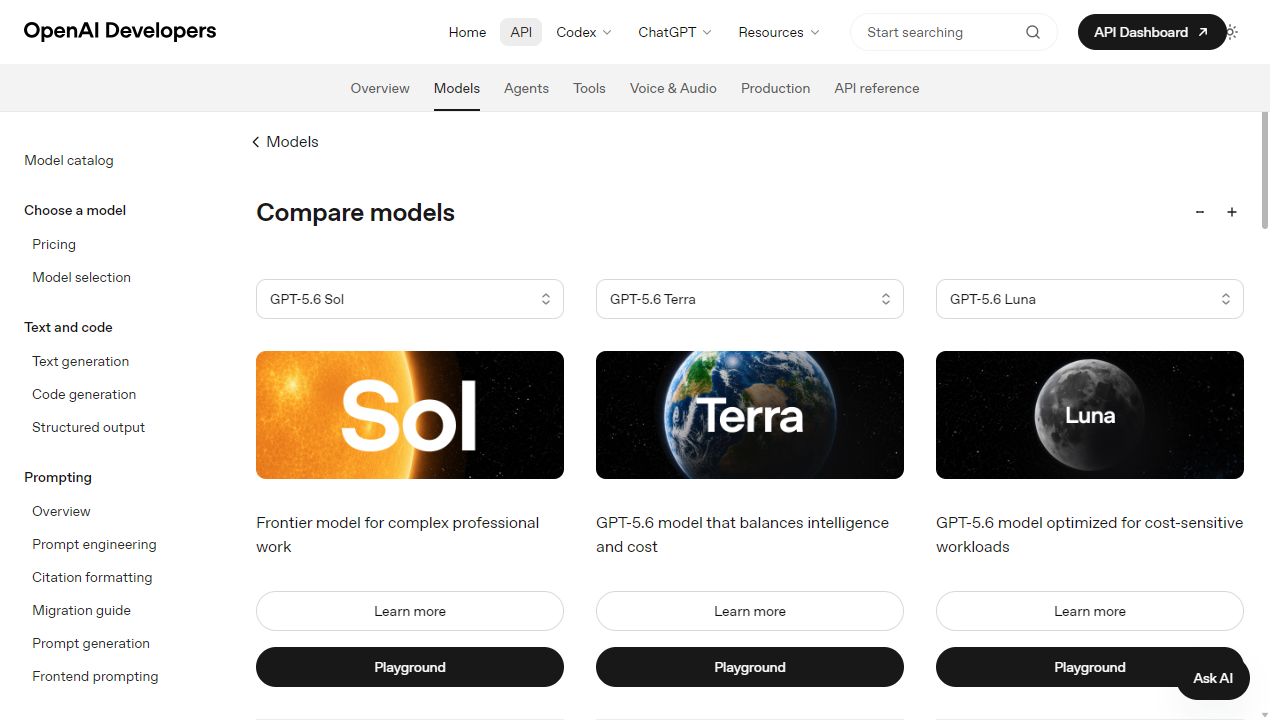
GPT-5.6 is rolling out by plan and workspace. OpenAI says GPT-5.6 Luna is becoming the default for Free and Go. On eligible paid plans, GPT-5.6 Sol powers Instant and the available Medium, High, and Extra High reasoning choices, while GPT-5.6 Sol Pro powers Pro. Access can still vary with rollout and administrator controls.
| Context comparison | Documented total context | What it applies to |
|---|---|---|
| MiniMax M3 API | Up to 1,000,000 tokens | Hosted MiniMax M3 calls; actual service behavior and guaranteed minimum should be checked for the chosen access path |
| ChatGPT Instant | 27K Free; 54K Go/Plus; 128K Pro | Consumer-plan values shown on ChatGPT’s pricing comparison at verification |
| ChatGPT Reasoning | Varies on Free; 256K Go/Plus; 400K Pro | Consumer-plan values, not OpenAI API model limits |
| GPT-5.6 API | 1,050,000 tokens for Sol, Terra, and Luna | OpenAI API model catalog; long-context pricing applies above the documented threshold |
The practical conclusion is narrower than “MiniMax has more context.” MiniMax M3 offers much more documented context than standard ChatGPT consumer conversations. For an API-to-API comparison, however, both providers now document roughly a million tokens. Developers should test retrieval accuracy across the full input length rather than assuming that every token is used equally well.
Which Is Better for Everyday Work, Writing, and Files?
ChatGPT is the more complete default for users who want to start working without assembling a model stack. Its plan pages document chat history, web/mobile access, file uploads, data analysis, vision, image creation, projects, memory, search, custom GPTs, scheduled tasks, deep research, Codex, and ChatGPT Work with access varying by plan.
That integration matters more than a single answer-quality claim. A writer can keep source files and instructions in a Project, analyze a spreadsheet, ask deep research for a cited brief, draft copy, generate an image, and move a longer deliverable into Work. ChatGPT Work is specifically positioned for documents, spreadsheets, presentations, reports, and Sites. Because it was still rolling out on July 17, it should be described as available to eligible accounts rather than universally available.
MiniMax Agent can also create documents, presentations, and multimedia results, and Mavis/Agent Teams targets long complex work. MiniMax is more compelling when the deliverable includes MiniMax-native video, voice, or music generation, or when a technical team wants M3 in its own pipeline. It is less straightforward as a universal daily assistant because its capabilities are distributed across Agent, Code, Hailuo, Audio, the API platform, and model-specific products.
- Choose ChatGPT: email drafting, document review, study, routine analysis, file-based Q&A, images, and an integrated personal workspace.
- Choose MiniMax: workflows where text work leads into MiniMax H3 video, Speech 2.8, the Music 3.0 family through an available product or entitled existing API account, or a custom M3 application.
- Evaluate both: formal reports, localization, long-document extraction, and high-volume content operations where factual accuracy and total cost must be measured on your own material.
Research and Long-Running Tasks
ChatGPT offers two relevant research paths. Deep research lets users select public web sources, uploaded files, and connected apps, review a proposed plan, follow progress, refine the task, and receive a structured report with citations or source links. ChatGPT Work is the newer agentic surface for longer analysis and finished deliverables. OpenAI says the former ChatGPT agent mode is no longer available, so articles that instruct users to choose “agent mode” are stale.
MiniMax introduced the Mavis name and Agent Teams on May 27, 2026. Its product announcement describes a leader that decomposes a goal, workers with specialized tools and contexts, and verifiers that check whether results are deliverable. This can be useful when work benefits from parallel collection and independent review.
Current MiniMax desktop scope: the MiniMax Agent changelog says its standalone deep-research skill was retired and now requires explicit
/team. MiniMax Code v3.0.54 added Browser Control inside its built-in browser, including reading pages, filling forms, uploading workspace files, and checking results. The changelog does not explicitly confirm that broader system-wide Computer Use has returned. Product-surface availability should not be inferred from the underlying M3 model’s documented computer-operation capability.
For a non-technical user who needs a cited report today, ChatGPT deep research is the clearer documented workflow. For a technical user exploring a multi-agent leader/worker/verifier pattern, MiniMax Agent Teams is distinctive. In either case, citations can be wrong, sources can be stale, and an agent can misread a document. Verify every consequential claim against the linked source.
MiniMax vs ChatGPT for Coding and AI Agents
Both ecosystems now have serious coding products, but the decision is about workflow and control rather than a provider benchmark table.
MiniMax M3, Mavis, and MiniMax Code
M3 is explicitly designed for coding, tool use, and long-horizon agent work. MiniMax provides OpenAI-compatible and Anthropic-compatible language-model access, guidance for third-party coding tools, and a Token Plan covering eligible resources. The desktop application was renamed MiniMax Code in version 3.0.33, and version 3.0.48 on July 13 introduced MiniMax Code 2.0’s rebuilt core.
MiniMax Agent Teams can split larger engineering work into roles such as developer, tester, and reviewer. That structure can be useful for parallel exploration and independent checks, but it increases token consumption, coordination overhead, and the need for deterministic tests. Read the current MiniMax Agent guide and MiniMax Code guide before relying on a feature described in an older launch article.
ChatGPT and Codex
OpenAI positions Codex as the dedicated software-development agent. Its supported surfaces include the ChatGPT desktop app, Codex CLI, IDE extension, web/cloud workflows, and remote access depending on account and platform. It can inspect a repository, edit files, run commands and tests, review diffs, and support parallel agent work. ChatGPT’s ordinary conversation surface remains useful for explanation and design, while Codex owns implementation-oriented repository work.
| Coding decision | MiniMax fit | ChatGPT/OpenAI fit |
|---|---|---|
| Use a polished repository agent | MiniMax Code is current and improving, with Code 2.0 released July 13 | Codex has broad documented desktop, CLI, IDE, cloud, review, and remote surfaces |
| Build a custom coding agent | M3 offers low listed rates, compatible APIs, long context, and downloadable weights | GPT-5.6 API offers a 1.05M context window, a broad hosted tool stack, and multiple capability/cost tiers |
| Parallel role-based execution | Agent Teams explicitly documents leader, worker, and verifier roles | Codex supports multiple agents and parallel work across supported workflows |
| Desktop computer operation | v3.0.46 historically recorded a temporary disablement; v3.0.54 Browser Control and v3.0.66 H3 integration do not explicitly reinstate broader system-wide Computer Use | Availability depends on Codex surface, operating system, plan, and workspace policy |
| Self-host the compared flagship | M3 weights are available under MiniMax’s license | GPT-5.6 is hosted; separate gpt-oss models are available but are not ChatGPT |
Recommendation: choose Codex when the integrated engineering product is the priority. Test M3 when unit economics, compatibility with existing agent tools, a million-token context, or self-hosting control matters. Run a repository-specific evaluation that includes setup success, code correctness, tests passed, unsafe actions, review burden, latency, and final cost.
API Access and Developer Experience
Neither a ChatGPT subscription nor a MiniMax consumer interface should be treated as an API entitlement. OpenAI states that ChatGPT Plus does not include API usage. MiniMax also distinguishes the Subscription Key used by Token Plan and purchased Credits from a standard pay-as-you-go API key.
| Developer consideration | MiniMax | OpenAI |
|---|---|---|
| Current flagship family | MiniMax-M3 | gpt-5.6-sol, gpt-5.6-terra, and gpt-5.6-luna |
| Recommended interface | MiniMax documents Anthropic-compatible access as recommended and also provides OpenAI-compatible access | Responses API for current reasoning, tools, and agentic workflows; model docs also list supported endpoints |
| Context | 1,000,000 for M3 | 1,050,000 for GPT-5.6 Sol/Terra/Luna |
| Multimodal input | M3 text, image, and video inputs in documented compatible chat calls | Current GPT-5.6 family supports text and image input; model-specific tools and endpoints vary |
| Media APIs | H3 through the separate Video Generation V2 API, plus separate speech, music, and image APIs; legacy Hailuo models use the older video route | Realtime/audio, image generation, and other specialized APIs; Sora Videos API is deprecated |
| Migration fit | Compatibility layers can reduce initial changes, but behavior still needs testing | Native OpenAI SDKs, Responses API, tool ecosystem, and broad official documentation |
Compatibility does not guarantee identical output formats, tool-call behavior, safety decisions, streaming events, caching, or error handling. Use the MiniMax API guide, pin model IDs where supported, validate schemas, implement retries with limits, keep API keys server-side, and run regression evaluations before switching a production workload.
Images, Video, Speech, Voice, and Music
MiniMax has a clearly separated specialist stack for programmatic media generation. Its current model catalog lists MiniMax-H3 for general-purpose multimodal video with native stereo sound, Speech 2.8 HD/Turbo, Music 3.0 and related music routes, and image-01. The same catalog places Hailuo 2.3, Hailuo 2.3 Fast, and Hailuo 02 under Legacy Models.
| Media task | MiniMax | ChatGPT/OpenAI | Practical reading |
|---|---|---|---|
| Create images | image-01 supports text-to-image and one-reference image workflows | ChatGPT image creation plus GPT Image API models | Both ecosystems support current image workflows; choose on output tests, controls, rights, and total cost |
| Create video | MiniMax-H3 accepts text and supported image, video, and audio context and generates 4–15-second output at 768P or 2K through Video Generation V2 | Sora web/app ended April 26; Sora API is deprecated and scheduled to end September 24 | MiniMax is the clearer current choice for a new dedicated video integration, but compare accepted-output quality, latency, rights, and total cost |
| Conversational voice | MiniMax Audio and speech APIs focus on synthesis, cloning, and voice workflows | ChatGPT Voice supports live conversation; OpenAI also offers Realtime/audio APIs | ChatGPT fits assistant conversation; MiniMax fits dedicated speech-generation pipelines |
| Generate songs | Music 3.0 is the current recommended model; its hosted REST API is closed to new users from August 20, 2026, while eligible existing paying users may continue | No comparable dedicated song-generation feature is listed in the checked ChatGPT plan material | For new MiniMax users, compare MiniMax Audio or the open-weight Music 3 model instead of assuming API access |
Developer limit note: MiniMax’s official table lists H3 V2 at 2 concurrent tasks for free-tier accounts and 15 for paid-tier accounts. The legacy Hailuo-series route is listed separately at 5 RPM free and 20 RPM paid. These are different limit types and should not be compared as the same quota.
For detailed MiniMax specifications, see the MiniMax H3 guide, the Hailuo 2.3 legacy reference, the Speech 2.8 guide, and the Music 3.0 guide. Do not treat generation access as a grant to imitate a protected voice, upload unlicensed media, or publish outputs without checking the applicable terms and local law.
MiniMax vs ChatGPT Pricing
The providers package value differently. ChatGPT subscriptions bundle a user-facing assistant and plan-dependent tools. MiniMax Token Plans bundle eligible API-platform resources through shared quota windows. Both providers also offer separate usage-based developer billing.
Subscription Comparison
| Offer | Checked price | What it is for | Billing caution |
|---|---|---|---|
| ChatGPT Free | $0 | Unlimited everyday text chats with GPT-5.6 Luna, subject to abuse-prevention safeguards | Separate limits apply to uploads, images, voice, data analysis, and other tools |
| ChatGPT Plus | $20/month | Expanded ChatGPT product access and eligible GPT-5.6 reasoning choices | OpenAI API usage is separate |
| ChatGPT Pro | $100/month or $200/month | Higher product limits and Pro access according to the selected tier | Model allowances and rollout can vary; API usage is separate |
| ChatGPT Business/Enterprise | Current checkout or sales quote | Managed workspace, administration, security, and business controls | Seat terms, credits, and features can differ |
| MiniMax Token Plan Plus | Docs $20; live purchase data observed $22/month | Interactive MiniMax developer use under shared quota windows | Final checkout amount controls |
| MiniMax Token Plan Max | Docs $50; live purchase data observed $55/month | Higher interactive quota and eligible multimodal resources | Not a consumer ChatGPT-style bundle |
| MiniMax Token Plan Ultra | Docs $120; live purchase data observed $132/month | Highest listed individual Token Plan tier | Not unlimited and not production pay-as-you-go credit |
Current Text API Rate Comparison
The figures below are US dollars per one million text tokens, checked against current official pricing on August 26, 2026. They are separate from ChatGPT subscriptions and exclude tools, storage, media services, taxes, retries, and third-party markups.
| Model / band | Input | Cached input/read | Output | Threshold note |
|---|---|---|---|---|
| MiniMax M3 Standard, ≤512K input | $0.30 | $0.06 | $1.20 | Higher M3 rates apply above 512K input |
| MiniMax M3 Standard, >512K input | $0.60 | $0.12 | $2.40 | Priority service is a separate MiniMax band |
| GPT-5.6 Luna, ≤272K input | $0.20 | $0.02 | $1.20 | Long-input rates apply above the documented threshold |
| GPT-5.6 Luna, >272K input | $0.40 | $0.04 | $1.80 | Higher rates apply to the full request |
| GPT-5.6 Terra, ≤272K input | $2.00 | $0.20 | $12.00 | Long-input rate: $4 input / $18 output |
| GPT-5.6 Sol, ≤272K input | $4.00 | $0.40 | $20.00 | Long-input rate: $8 input / $30 output |
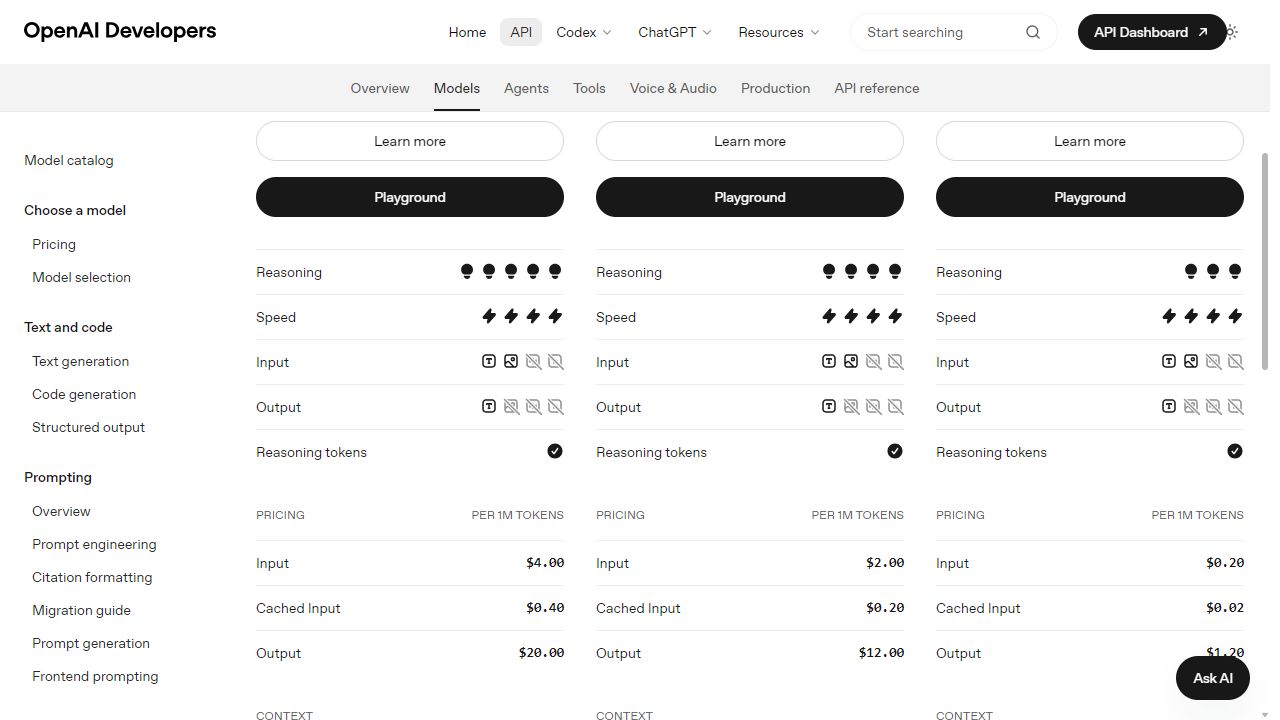
Correct price conclusion: M3 Standard costs less than GPT-5.6 Terra and Sol at the checked Standard rates. It does not cost less than Luna: at the short band Luna input is lower and output is the same; in the respective long-input bands Luna is lower on both input and output. Compare cost per accepted result, including reasoning output, cache behavior, tools, retries, latency, and review.
OpenAI renamed Priority processing to Fast mode on July 30, 2026. The API currently accepts the documented compatibility values priority or fast; editorial descriptions should use the current Fast mode label.
Business Privacy, Security, and Administration
OpenAI publishes a clear business-data commitment: by default, it does not use data from ChatGPT Business, Enterprise, Edu, Healthcare, Teachers, or the API platform to train its models. OpenAI also states that business data is encrypted at rest and in transit and documents controls such as SAML SSO, administration, retention options, role-based access, and other enterprise features depending on plan.
That commitment should not be copied onto every consumer account. OpenAI’s Plus help says consumer conversations may be used to improve models and that users can opt out through data controls. Select the appropriate workspace, configure controls, and review the current privacy policy before entering confidential information.
MiniMax’s privacy overview explicitly says its services differ by functionality, user type, and deployment model, so the applicable practices may differ across Open Platform, Agent, Audio, and Video. A business must review the specific policy for the product it will use rather than relying on a general MiniMax brand statement. MiniMax Agent’s policy describes account, device, usage, message, interaction, and other information categories and the circumstances in which information may be processed or disclosed.
| Business check | ChatGPT/OpenAI | MiniMax |
|---|---|---|
| Training commitment | No training on business data by default for named business products and API | Do not assume a universal promise; inspect the service-specific privacy policy and contract |
| Workspace administration | Business and Enterprise publish centralized controls, with broader Enterprise features | Agent and Token Plan team capabilities exist; verify current admin, seat, and deployment terms |
| Encryption statement | OpenAI states AES-256 at rest and TLS 1.2 or higher in transit for business data | Use the exact applicable policy and security documentation; do not infer certifications from marketing |
| Sensitive data decision | Use a managed business workspace with configured controls, not a personal account by default | Choose the correct service/deployment and complete legal, security, retention, and vendor review |
Neither provider should receive secrets, health records, legal material, customer data, source code, or regulated information merely because a chat box is convenient. Follow your organization’s data-classification rules, minimize inputs, remove identifiers, restrict connectors, and use the guidance in what not to paste into AI tools.
Open Weights, Licensing, and Deployment Control
MiniMax publishes M3 weights through its official Hugging Face organization. The model card describes approximately 428 billion total parameters with about 23 billion activated and a 1M context. This gives qualified teams an option to run the compared M3 model on infrastructure they control.
Call this open-weight, then read the MiniMax community license. Do not translate weight availability into “no restrictions,” “free production hosting,” or “easy local deployment.” Hardware, quantization, inference software, multimodal support, monitoring, security, and operational expertise can outweigh hosted-API savings.
ChatGPT and the GPT-5.6 hosted models are not downloadable. OpenAI separately publishes gpt-oss-120b and gpt-oss-20b under an open-weight program, but OpenAI says these models are not served through its API and are not available in ChatGPT. They should be evaluated as separate models, not cited as evidence that ChatGPT itself can be self-hosted.
Who Should Choose MiniMax AI or ChatGPT?
Choose ChatGPT If You Need
- One integrated assistant for writing, files, search, images, voice, projects, and memory.
- A ready-to-use deep research workflow with source selection and cited reports.
- ChatGPT Work for longer reports and editable deliverables, when available to your account.
- Codex as a dedicated repository and software-engineering agent.
- A managed business workspace with documented no-training-by-default business-data treatment.
- Broad end-user adoption without asking employees to assemble separate model and media products.
Choose MiniMax If You Need
- A tested workload where M3 delivers a lower total cost per accepted result than the chosen GPT-5.6 model.
- MiniMax-compatible access inside existing coding tools and agent frameworks.
- Agent Teams with explicit leader, worker, and verifier roles.
- Dedicated MiniMax H3 video, Speech 2.8, and image APIs plus the Music 3.0 family; hosted music access is limited to eligible existing paying API users.
- Downloadable M3 weights for licensed private deployment or research.
- A MiniMax-specific creative workflow spanning script, video, speech, and music.
Run a Pilot Before Choosing If You Need
- Reliable legal, medical, financial, compliance, or safety-critical analysis.
- Agent autonomy over production systems, browser sessions, credentials, or customer communications.
- Accurate extraction across hundreds of thousands of tokens.
- Consistent code changes across a large, poorly tested repository.
- Commercial use of generated voices, music, images, or video.
- Strict data residency, retention, audit, or sector-specific contractual requirements.
Should You Use MiniMax and ChatGPT Together?
For advanced teams, the best architecture may be complementary rather than exclusive. A marketing workflow could use ChatGPT deep research or Work for the brief, ChatGPT or Codex for data processing and automation, Hailuo for video, Speech 2.8 for narration, and MiniMax Audio, open-weight Music 3, or an entitled existing Music API account for an original music draft. A developer could use Codex for repository implementation while evaluating M3 as the lower-cost runtime behind selected application tasks.
- Define the deliverable and acceptance criteria in ChatGPT or your project system.
- Use deep research or Work for sourced planning where available.
- Use Codex for code changes, tests, and repository review.
- Use MiniMax media APIs only for the assets they are designed to generate.
- Store prompts, model IDs, settings, rights records, and output provenance.
- Review every factual, legal, brand, security, and accessibility requirement before release.
A two-provider workflow adds operational cost: two sets of keys, policies, bills, logs, outages, safety behavior, and data flows. Use both only when the specialization creates measurable value.
Final Verdict: MiniMax AI vs ChatGPT
ChatGPT is the stronger default product for most individual and workplace users. Its advantage is the integrated experience across conversation, files, projects, memory, images, voice, deep research, ChatGPT Work, Codex, and managed business workspaces. That conclusion is about product coverage and convenience, not a claim that every ChatGPT answer is better.
MiniMax is the stronger fit for several specialized technical and creative workflows. M3 is cheaper than GPT-5.6 Terra and Sol at the checked Standard rates, though not Luna; M3 also has an official downloadable weight release. MiniMax maintains current specialist routes for H3 video, speech, and image, while hosted Music access is restricted for new users. Agent Teams provides a leader/worker/verifier structure for longer tasks.
- Choose ChatGPT for an all-in-one daily assistant and established knowledge-work environment.
- Choose MiniMax for a tested cost-sensitive M3 integration, MiniMax media generation, or M3 deployment control.
- Use both when ChatGPT’s planning and engineering tools complement MiniMax’s specialist media or runtime capabilities.
Recheck official pages before purchasing. GPT-5.6 and ChatGPT Work are actively rolling out, MiniMax Agent features are changing, and prices, quotas, model IDs, privacy terms, and deprecation dates can change after this verification date.
MiniMax AI vs ChatGPT FAQ
Is MiniMax AI better than ChatGPT?
Not universally. MiniMax is a better fit for some API-cost, open-weight M3, video, speech, music, and MiniMax Agent Team workflows. ChatGPT is a better fit for most users seeking one integrated assistant for daily work, files, research, images, voice, coding, and business collaboration.
Which is better for coding, MiniMax M3 or ChatGPT?
Choose ChatGPT with Codex when you prioritize its integrated repository, terminal, testing, review, IDE, and remote workflow. Evaluate MiniMax M3 when compatible agent access, a 1M context window, downloadable weights, or measured cost per successful task matters. Do not assume M3 is cheaper than Luna; test the same repository and acceptance criteria.
Does MiniMax M3 have a larger context window than ChatGPT?
Compared with consumer ChatGPT plan limits, yes: MiniMax documents up to 1M tokens for M3, while the checked ChatGPT plan table lists lower Instant and Reasoning context windows. Compared with the OpenAI API, no clear size advantage exists: GPT-5.6 Sol, Terra, and Luna each list a 1.05M context window.
Is MiniMax cheaper than ChatGPT?
MiniMax M3 is cheaper than GPT-5.6 Terra and Sol at the checked Standard rates, but not GPT-5.6 Luna. Subscription value is not directly comparable: ChatGPT bundles an end-user workspace, while MiniMax Token Plans cover eligible platform resources through quota windows. Compare total cost per accepted result.
Is ChatGPT agent still available?
No. OpenAI’s current help article says ChatGPT agent is no longer available and directs users to ChatGPT Work for longer, multi-step tasks and finished deliverables. Work was still gradually rolling out to eligible accounts on July 17, 2026.
Is MiniMax Agent the same as Mavis?
Mavis is the name MiniMax introduced for the upgraded MiniMax Agent experience in May 2026. It is not a separate foundation model. The desktop application is now branded MiniMax Code, and current feature status should be checked in the Agent changelog.
Which is better for AI video?
MiniMax is the more practical current choice for a new dedicated video-generation workflow because MiniMax-H3 is documented for 4–15-second 768P/2K output with native stereo sound and multimodal references through Video Generation V2. Hailuo 2.3 and 2.3 Fast remain documented legacy options, not the current default. OpenAI discontinued the Sora web/app experience on April 26, 2026 and says the deprecated Sora API will shut down on September 24, 2026.
Can ChatGPT generate music like MiniMax Music 3.0?
The checked ChatGPT plan documentation does not list a dedicated text-to-song product comparable to MiniMax Music 3.0. ChatGPT can help with lyrics, structure, prompts, production planning, and analysis. MiniMax documents Music 3.0, but its hosted Music API is unavailable to new users from August 20, 2026; eligible existing paying users may continue, while new users are directed to MiniMax Audio or the open-weight Music 3 model.
Can I self-host MiniMax or ChatGPT?
MiniMax publishes M3 weights under its community license, so qualified teams can evaluate self-hosting the compared model. ChatGPT and GPT-5.6 are hosted products and cannot be self-hosted. OpenAI separately offers gpt-oss open-weight models, but they are not available in ChatGPT or through the OpenAI API.
Which is safer for confidential business data?
OpenAI publishes the clearer broad business commitment for its named business products and API: no training on business data by default, plus encryption and workspace controls. MiniMax requires product-by-product privacy review. In both cases, use an approved business account and contract, minimize sensitive inputs, configure access, and complete your organization’s security review.
Official Sources Checked
The following primary sources were checked on July 17, 2026; MiniMax video-model sources were rechecked on August 13, 2026. OpenAI claims in this article use only official OpenAI or ChatGPT documentation.
MiniMax Sources
- MiniMax model catalog
- Official MiniMax H3 announcement
- Video Generation V2 create reference
- MiniMax rate limits
- MiniMax text generation and M3 invocation
- MiniMax M3 model page
- Official MiniMax M3 model card and weights
- MiniMax pay-as-you-go pricing
- MiniMax Token Plan overview and pricing
- Mavis and Agent Teams announcement
- MiniMax Agent and MiniMax Code changelog
- MiniMax privacy-policy overview
OpenAI Sources
- ChatGPT plan comparison
- GPT-5.6 in ChatGPT
- OpenAI API model catalog
- OpenAI API pricing
- ChatGPT Work and Codex
- ChatGPT agent retirement notice
- Deep research in ChatGPT
- ChatGPT Plus price and features
- ChatGPT Pro tiers
- OpenAI enterprise privacy commitments
- OpenAI business data security and privacy
- Sora discontinuation notice
- OpenAI gpt-oss open-weight models
Independence disclosure: Provider documentation can change without notice. Treat prices, limits, model availability, and privacy terms as dated information and reconfirm them before purchase or production deployment.