

Comparison, model, pricing, and access snapshot verified: August 26, 2026.
Independent-site notice: MiniMax-AI.chat is an independent educational website. It is not MiniMax’s official website and is not affiliated with, endorsed by, or sponsored by MiniMax, xAI, SpaceXAI, or X. Product names and trademarks belong to their respective owners. The providers control product access, prices, limits, availability, and terms.
Quick answer: MiniMax AI and Grok AI overlap, but they are not one-for-one substitutes. MiniMax is the stronger first test when a workload needs MiniMax M3’s documented 1-million-token context, lower currently listed text-token rates, downloadable M3 weights, or one provider with dedicated language, video, speech, image, and music model families. Hosted Music API access is limited to eligible existing paying users after August 20, 2026. Grok is the stronger first test when a workflow depends on first-party X Search, managed web and code tools, Grok Build, or a consumer assistant that combines chat, search, voice, image, and video features.
For a useful comparison, match the products correctly: compare MiniMax M3 with grok-4.6 for model and API work, MiniMax Code with Grok Build for coding agents, and MiniMax’s creative APIs with Grok Imagine and Voice for media production.
Editorial verdict: Choose MiniMax as the first evaluation candidate for long context, lower listed text-token rates, current public model weights, or broad multimodal production. Choose Grok as the first candidate for live X research and a managed tool ecosystem. Neither provider is universally better; test both on the same real tasks before a production commitment.
MiniMax AI vs Grok AI: Quick Comparison
| Category | MiniMax AI | Grok AI |
|---|---|---|
| Current headline language model | MiniMax-M3 | grok-4.6 |
| Documented context | Up to 1M tokens for M3 | 500K for Grok 4.6; xAI also lists other 1M-context models |
| Primary emphasis | Coding, long-running agents, long context, multimodal understanding, and dedicated creative APIs | Coding, agentic work, knowledge work, managed tools, consumer assistance, and web/X workflows |
| Search tools | Server-side web_search at $0.01/request | Web Search and X Search at $5/1,000 calls each |
| Flagship text API entry rate | M3 Standard at ≤512K input: $0.30/M input, $0.06/M cache read, $1.20/M output | Grok 4.6 at <200K prompt: $2/M input, $0.50/M cached input, $6/M output |
| Coding product | MiniMax Code 2.0; latest build and latest feature-bearing release v3.0.66 (August 19) | Grok Build, with Grok 4.6 documented as its default model |
| Local option | M3 weights and deployment guidance are public under the MiniMax Community License | Grok Build’s harness is open source and local-first; Grok 4.6 weights are not publicly offered |
| Creative generation | Dedicated video, speech, music, and image models | Dedicated Imagine image/video and Voice APIs |
These are provider-listed specifications and prices, not a prediction of final cost or quality. Long prompts, cache behavior, reasoning, retries, tool calls, media generation, infrastructure, and human correction time can change the practical result.
Compare the Correct MiniMax and Grok Products
“MiniMax AI vs Grok AI” can describe several decisions. A person comparing chat apps is not making the same choice as a developer comparing APIs or a company evaluating local deployment. Keep these layers separate.
| Decision layer | MiniMax option | Grok option | What to compare |
|---|---|---|---|
| Foundation model/API | MiniMax-M3 | grok-4.6 and other listed Grok models | Context, modalities, tools, price, latency, reliability, and access |
| Coding agent | MiniMax Code | Grok Build | Repository workflow, terminal tools, worktrees, permissions, review, and model access |
| General assistant | MiniMax Agent and related surfaces | Grok on grok.com, mobile apps, and X | Search, files, voice, quotas, privacy settings, and interface |
| Creative APIs | Hailuo, Speech 2.8, and Image-01; Music 3.0 hosted API only for eligible existing paying users | Grok Imagine and Grok Voice | Required modality, controls, output format, price, rights, and review |
| Local deployment | M3 weights under the Community License | Open-source Grok Build harness, not Grok 4.6 weights | License, hardware, security, maintenance, and total operating cost |
A feature in a consumer app does not automatically exist in an API, and an API capability does not prove a subscription quota. The same rule applies to MiniMax: M3 model capabilities, MiniMax Code features, Agent workflows, and Hailuo or Music endpoints are different product surfaces.
On This Page
- MiniMax M3 vs Grok 4.6
- MiniMax Code vs Grok Build
- What MiniMax Code v3.0.52 added
- Web Search and X Search
- API pricing and tool costs
- Video, image, speech, voice, and music
- Consumer and developer plans
- Local deployment and licenses
- Privacy and business data
- Decision guide
- Frequently asked questions
MiniMax M3 vs Grok 4.6: Models, Context, and Reasoning
MiniMax M3 is MiniMax’s current M-series flagship for coding, agents, long context, and multimodal understanding. MiniMax documents text, image, and video input, text output, a context window of up to 1 million tokens, and downloadable weights. Its separate creative models generate video, speech, music, and images; an ordinary M3 text response should not be described as generating all of those media formats itself.
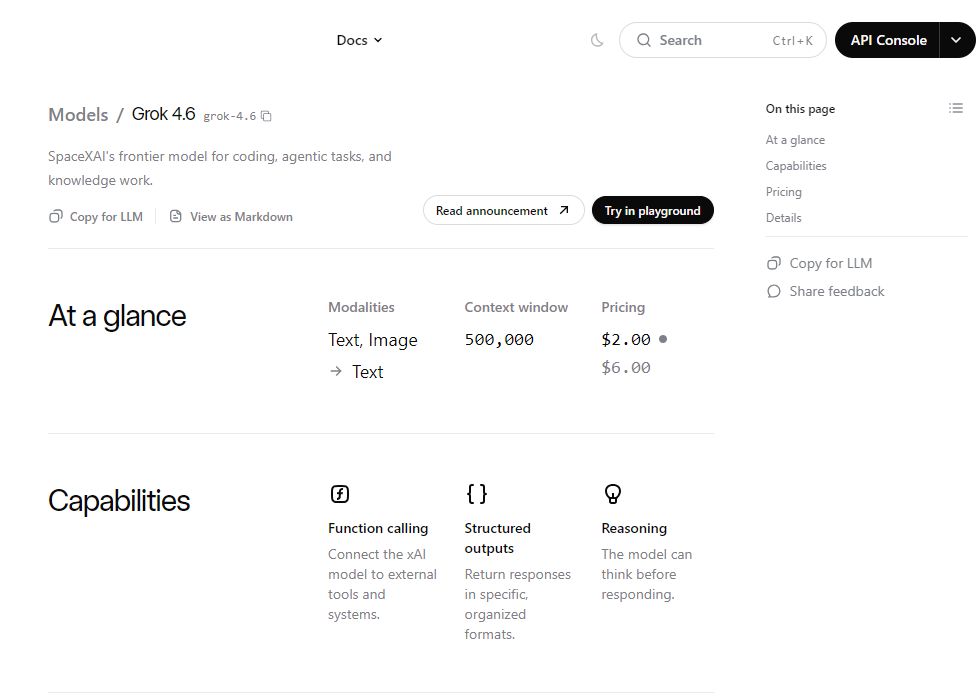
Grok 4.6 is xAI’s current flagship for coding, agentic tasks, and knowledge work. The official documentation lists text and image input, text output, a 500,000-token context window, configurable reasoning levels of low, medium, or high, and high as the documented default. It supports the Responses API and Chat Completions.
| Specification | MiniMax-M3 | grok-4.6 |
|---|---|---|
| Maximum documented context | 1M tokens | 500K tokens |
| Documented inputs | Text, image, and video | Text and image |
| Output | Text | Text |
| Reasoning control | Thinking behavior depends on the selected MiniMax-compatible endpoint and should be set explicitly | Low, medium, high, or xhigh; set the level explicitly in repeatable evaluations |
| Long-context price boundary | Input above 512K uses the higher M3 band | A prompt of at least 200K uses the higher Grok 4.6 band for all tokens in that request |
Context size is a capacity limit, not a quality guarantee. Sending an entire repository or archive can add cost and noise. Compare full-context calls with retrieval, indexing, or staged analysis, and score whether each model can locate evidence near the beginning, middle, and end of a long input.
The 500K figure applies specifically to Grok 4.6. xAI’s current pricing catalog also lists 1M-context models such as Grok 4.3, so it would be inaccurate to say that every Grok model is limited to 500K.
MiniMax Code vs Grok Build: Coding Agents
Both ecosystems target repository work and long-running software tasks. The practical choice depends on the model, harness, tools, permissions, and review flow—not only the provider name.
Within MiniMax, keep MiniMax Agent separate from the coding-focused MiniMax Code desktop and CLI experience. Product-interface features can change by release even when the underlying M3 model remains the same.
Grok 4.6 is available in Grok Build. xAI also lists the separate early-access grok-build-0.1 API model with a 256K context window. Do not assume a consumer Grok subscription, the open-source Grok Build harness, and either hosted model share the same billing or limits.
What the v3.0.48 and v3.0.46 Notes Actually Documented
The v3.0.48 and v3.0.46 changelog entries documented the MiniMax Code 2.0 core rebuild, reliability and conversation-state improvements, worktree and Agent Team changes, security hardening, the retirement of the standalone deep-research skill in favor of explicit /team invocation, and the temporary disablement of Computer Use. Those entries describe specific historical builds rather than the newest release note.
The official page groups the core rebuild under v3.0.48~v3.0.49, dated July 13, 2026. The performance improvements in that note are MiniMax’s own release claims, not independent benchmark results.
Current MiniMax Code release and the historical v3.0.52 update
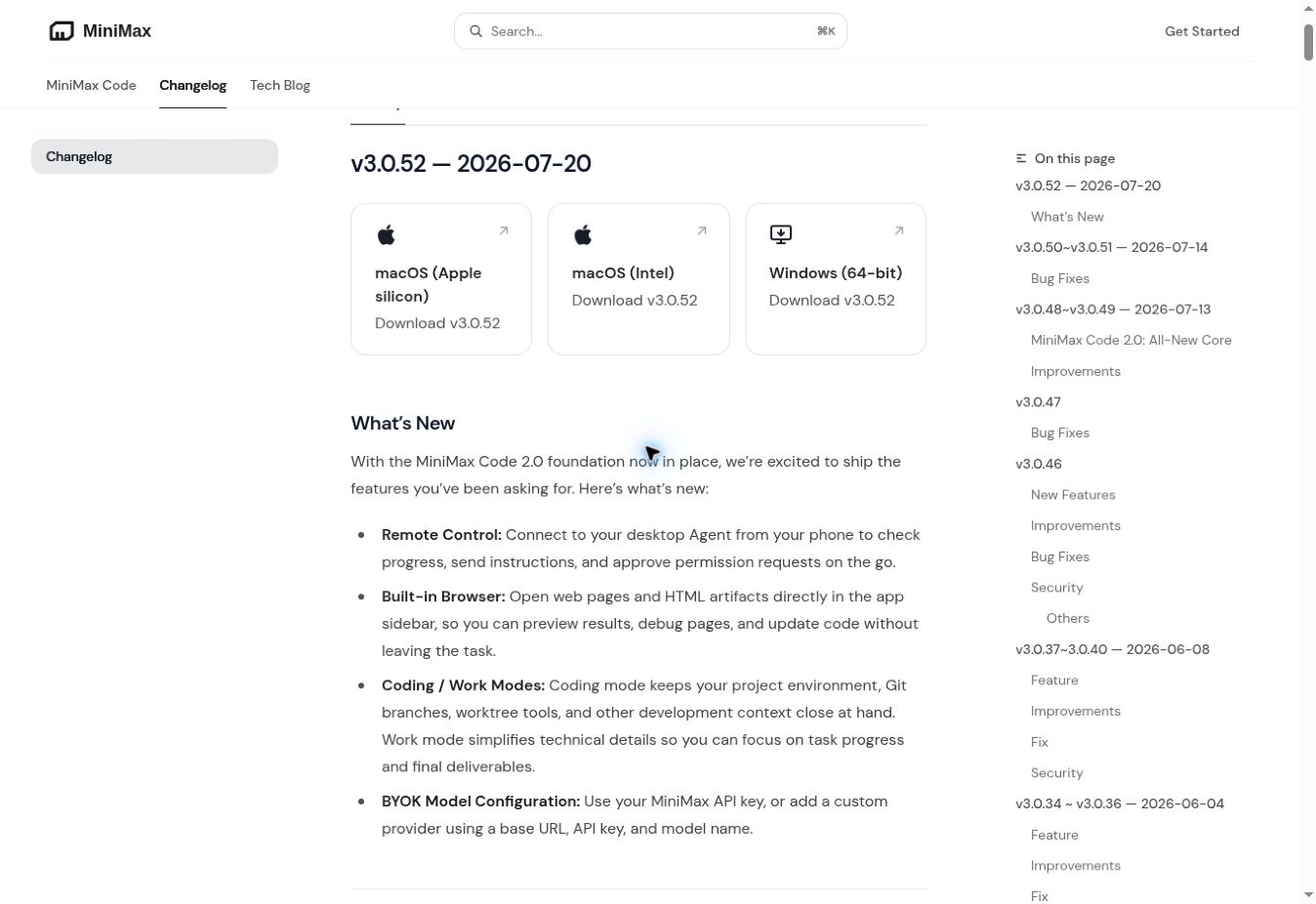
Latest build and latest feature-bearing release: MiniMax Code v3.0.66, released August 19, 2026. It integrates H3 video generation and adds Site management, Fork & Rewind, Plan mode, MCP Servers configuration, text-selection comments, and smoother previews. The earlier v3.0.65 fix-only and v3.0.63 feature releases remain historical. The historical v3.0.52 release, dated July 20, listed four additions:
- Remote Control: connect from a phone to check desktop Agent progress, send follow-up instructions, and approve permission requests.
- Built-in Browser: open web pages and HTML artifacts inside the app sidebar to preview results, debug pages, and update code without leaving the task.
- Coding and Work modes: Coding keeps development context such as the project environment, Git branches, and worktree tools visible; Work reduces technical interface detail and focuses on task progress and deliverables.
- BYOK model configuration: use a MiniMax API key or configure a custom provider with a base URL, API key, and model name.
MiniMax Code v3.0.54 added Browser Control inside its built-in browser, including reading pages, filling forms, uploading workspace files, and checking results. The changelog does not explicitly confirm that broader system-wide Computer Use has returned. Remote Control remains a separate phone companion for a running desktop Agent session, not remote mouse or remote-desktop access.
Which Coding Agent Is the Better Starting Point?
| Requirement | Better first test | Why |
|---|---|---|
| 1M-context flagship and public model weights | MiniMax Code with M3 | M3 documents 1M context and public weights under a community license |
| Phone follow-up and approvals for a desktop task | MiniMax Code v3.0.52 | Remote Control is explicitly documented for progress, instructions, and permission approval |
| Managed Web Search, X Search, code execution, and file tools | Grok/xAI workflow | xAI documents these hosted tools and their call prices |
| Open-source coding-agent harness | Grok Build | The harness and terminal interface are open source; this does not publish Grok 4.6 weights |
| Custom-provider configuration in the current desktop app | MiniMax Code v3.0.52 | The release adds BYOK configuration for MiniMax or a custom provider |
SpaceXAI open-sourced the Grok Build agent harness and terminal UI on July 15, 2026. That source covers the agent loop, context assembly, tools, extensions, and terminal interface. It does not make Grok 4.6 an open-weight model.
Live Web Search and X Search
Grok has the clearer first-party option for research that depends on X. xAI documents separate Web Search and X Search tools. Web Search browses the public web; X Search is designed for posts, profiles, and threads. The Grok 4.6 guide also makes an important distinction: the base model does not automatically know current events. A current-information workflow must enable the relevant search tool.
MiniMax also has first-party server-side search. Its Pay as You Go table lists web_search at $0.01 per request. Grok remains the more direct choice for X-native monitoring because X Search is a separately documented first-party tool.
How to Test Search Quality
- Prepare 20 recent questions with known authoritative answers.
- Require links to primary sources and verify that each source supports the attached claim.
- Record search calls and token cost, not only the final answer.
- Score stale facts, unsupported conclusions, duplicated sources, and missed corrections.
- Repeat the evaluation because indexing and tool availability can change.
MiniMax vs Grok API Pricing
The following provider-listed USD rates were verified on July 24, 2026 from the official MiniMax Pay as You Go table and xAI API pricing page. They compare text generation, not subscriptions, media generation, tax, enterprise contracts, or third-party reseller prices.
| API model or band | Context | Input / 1M | Cached input / 1M | Output / 1M |
|---|---|---|---|---|
| MiniMax M3 Standard, input ≤512K | Up to 1M | $0.30 | $0.06 cache read | $1.20 |
| MiniMax M3 Standard, input >512K | Up to 1M | $0.60 | $0.12 cache read | $2.40 |
| Grok 4.6, prompt <200K | 500K maximum | $2.00 | $0.50 | $6.00 |
| Grok 4.6, prompt ≥200K | 500K maximum | $4.00 | $1.00 | $12.00 |
| Grok 4.3, prompt <200K | 1M maximum | $1.25 | $0.20 | $2.50 |
| Grok 4.3, prompt ≥200K | 1M maximum | $2.50 | $0.40 | $5.00 |
For Grok 4.6, once the prompt reaches 200,000 tokens, xAI applies the long-context rates to all tokens in that request. For MiniMax M3, input above 512K uses the higher M3 Standard band. On list price alone, M3 is cheaper than Grok 4.6 in the categories shown, but cost per successful task can reverse the result if one workflow needs more output, retries, tools, infrastructure, or human correction.
Search and Tool Costs
| Provider | Tool | Listed price |
|---|---|---|
| MiniMax | web_search | $0.01/request |
| Grok | Web Search | $5/1,000 calls |
| Grok | X Search | $5/1,000 calls |
| Grok | Code Execution | $5/1,000 calls |
| Grok | File Attachments search | $10/1,000 calls |
| Grok | Collections Search | $2.50/1,000 calls |
An agent can invoke more than one tool while answering a request, so do not estimate every question as one search call. Log actual tool usage from responses. For more MiniMax rates, use the MiniMax pricing guide; for implementation routes, see the MiniMax API guide.
Video, Image, Speech, Voice, and Music
MiniMax has the broader explicitly separated creative-model catalog. Its current official catalog lists MiniMax-H3 as the current video model and places Hailuo 2.3, Hailuo 2.3 Fast, and Hailuo 02 under Legacy Models. Speech 2.8, Image-01, and Music 3.0 remain separate specialist families. Grok’s creative stack is organized around Imagine image/video and Voice APIs, including real-time voice, text to speech, and speech to text.
| Need | MiniMax route | Grok route | What to test |
|---|---|---|---|
| Understand an image or video | MiniMax M3 multimodal input | Supported Grok model/product input | Understanding is different from generation |
| Generate video | MiniMax-H3 for a new API evaluation; legacy Hailuo variants only where the V1 workflow is specifically required | Grok Imagine video | Duration, resolution, source inputs, editing, queue behavior, and price |
| Generate speech | Speech 2.8 | Grok Voice TTS or real-time Voice | Languages, voices, latency, consent, and controls |
| Transcribe audio | Confirm the current MiniMax audio route for the project | Grok speech-to-text route | Do not confuse text-to-speech with speech-to-text |
| Generate music | Music 3.0 through MiniMax Audio, open-weight deployment, or an eligible existing paying hosted-API account | No dedicated music-generation API is listed in the xAI developer catalog as of July 24, 2026 | Rights, voice authorization, labels, and destination-platform rules |
| Generate or edit images | Image-01 and applicable product tools | Grok Imagine image generation/editing | Typography, identity consistency, edit fidelity, and terms |
Do not select a provider because it has more modality labels. Use the same approved inputs, brief, number of attempts, and review rubric. Include rejected generations in cost and turnaround measurements.
Consumer Plans and Developer Access
Subscriptions and API billing should not be placed in one price table as if their quotas were equivalent.
MiniMax Token Plan
MiniMax’s Token Plan documentation lists Plus/Max/Ultra at $20/$50/$120 per month, while live first-party purchase data returned $22/$55/$132 on August 26, 2026. MiniMax does not explain the discrepancy, so verify the final checkout amount. Plans use five-hour rolling and weekly limits and are not unlimited API plans.
Grok, SuperGrok, X, and the API
The official Grok plan comparison lists a Free tier and SuperGrok at $30/month, with Grok 4.6 access currently included. Displayed plans, prices, limits, and availability can vary by country, account, and checkout surface. X subscriptions are separate from SuperGrok, and neither creates an xAI API balance. The xAI API has its own keys, team limits, and usage-based billing.
Grok 4.6 is the current documented flagship, but access can still depend on account, region, product surface, and team configuration. Check the exact model ID in the console used by the deploying team.
Local Deployment, Open Weights, and Licenses
MiniMax has the clearer option when the requirement is to obtain current flagship-model weights. The official M3 repository publishes model materials and deployment guidance. The weights use the MiniMax Community License, not an unrestricted MIT or Apache license.
The published license contains conditions for commercial use, including attribution and revenue-related requirements. Read the current license and obtain legal advice where appropriate; this comparison is not a substitute for a license review.
Grok requires a different description. The Grok Build harness can be inspected, compiled, and pointed at local inference, but that does not make Grok 4.6 weights public. Treat the harness license, the selected inference model’s license, and any xAI service terms as separate layers.
Privacy, Data Handling, and Business Use
Do not treat the consumer app, X integration, API, enterprise service, and self-hosted model as if they had identical data rules.
xAI’s consumer terms describe controls for whether logged-in user content is used for product improvement and model training and say deletion may take up to 30 days, subject to stated exceptions. The enterprise terms govern API and business use and describe different protections. Confirm the exact contract, settings, retention, and any Zero Data Retention configuration rather than transferring a consumer-setting claim to an enterprise account.
MiniMax publishes separate platform terms and privacy materials. Self-hosting M3 can change the data path, but the deploying organization then owns infrastructure security, logs, identity and access management, backups, updates, and incident response. Read the MiniMax privacy and security guide for a product-by-product review.
- Do not send secrets, regulated records, customer data, or unreleased code until the applicable terms and controls permit it.
- Separate consumer settings from API and enterprise contractual protections.
- Confirm retention, training use, subprocessors, data region, deletion, and human-review practices.
- Use redaction, least privilege, isolated test data, and human approval for consequential agent actions.
- Recheck connected-service terms when either agent sends data to X, files, storage, MCP servers, or another third party.
Which Should You Choose?
| Main requirement | Better starting point | Reason |
|---|---|---|
| 1M-context current flagship | MiniMax M3 | M3 documents 1M; Grok 4.6 documents 500K |
| Lower listed flagship text-token rates | MiniMax M3 | Its current Standard rates are lower in the compared token categories |
| Live X posts, profiles, and threads | Grok | X Search is a first-party managed tool |
| Current flagship weights for local serving | MiniMax M3 | Weights and deployment guidance are public under a community license |
| Open-source coding-agent harness | Grok Build | The harness and terminal UI are published; the Grok 4.6 model remains separate |
| Music-generation API | MiniMax for eligible existing paying API users | Music 3.0 remains in the model catalog, but the hosted API is closed to new users and free variants are discontinued from August 20, 2026 |
| Managed web/X/code/file tools | Grok | xAI documents a broad hosted tool menu and per-call prices |
| Language, video, speech, image, and music model families from one provider | MiniMax, with a hosted-music caveat | MiniMax lists current families across all five areas, but new users cannot activate the hosted Music API |
| Sensitive enterprise work | Contract-dependent | Compare the exact data terms, controls, region, and deployment |
Run a Small Evaluation Before Switching
- Select 25–50 real tasks across easy, typical, and difficult cases.
- Use equivalent instructions, files, tools, permissions, and output constraints.
- Record the exact model ID, date, reasoning setting, context size, tool calls, retries, and price band.
- Score factual accuracy, code correctness, instruction following, source quality, latency, cost, and human correction time.
- Include failures: unavailable tools, malformed output, rate limits, long-context degradation, and unsafe proposed actions.
- Choose the provider or routing policy that minimizes total work, not only the token price.
A mixed architecture can be reasonable—for example, Grok for live X/web discovery and MiniMax for long-context processing—provided that the team measures duplicate context, integration overhead, data movement, and failure handling.
Important Limitations
- No provider benchmark is used here to declare an overall winner.
- Launch claims are not treated as independently verified performance.
- Core comparison facts and listed prices retain the July 24, 2026 snapshot; MiniMax Code release status and Music API availability were refreshed August 20, 2026, while the video catalog was refreshed August 13, 2026.
- A larger context window does not guarantee better answers or effective use of every token.
- Open weights do not mean an unrestricted open-source license.
- Open-sourcing Grok Build does not publish Grok 4.6 model weights.
- MiniMax Code v3.0.54 documents Browser Control inside the built-in browser; the changelog does not explicitly confirm that broader system-wide Computer Use has returned.
- Consumer, API, X, enterprise, and local-deployment data rules are separate.
- Generated content and agent actions still require factual, security, rights, and policy review.
Final Verdict
Choose MiniMax AI as the first test when you need 1M context in the current flagship, lower listed text-token rates, current public model weights, or a production stack with dedicated language, video, speech, and image APIs plus the Music 3.0 family; hosted music requires an eligible existing paying account. MiniMax Code v3.0.52 historically added Remote Control, a built-in browser, Coding and Work modes, and BYOK configuration. MiniMax Code v3.0.54 later added Browser Control inside its built-in browser, including reading pages, filling forms, uploading workspace files, and checking results. The changelog does not explicitly confirm that broader system-wide Computer Use has returned.
Choose Grok AI as the first test when the job depends on live web research, first-party X Search, a general consumer assistant, or xAI’s managed search, code execution, file, collection, Imagine, Voice, and Grok Build ecosystem.
The accurate answer is conditional: MiniMax has the clearer current context, listed-cost, and local-weight proposition; Grok has the clearer live-X and hosted-tool proposition. Evaluate the exact product surface and version you will deploy.
MiniMax AI vs Grok AI FAQ
Is MiniMax AI better than Grok AI?
Not for every task. MiniMax is a strong first test for M3’s 1M context, lower listed text-token prices, local weights, and broad creative APIs. Grok is a strong first test for live Web Search, X Search, a consumer assistant, and managed hosted tools.
Which is better for coding: MiniMax M3 or Grok 4.6?
MiniMax M3 may fit repository-scale context, lower-cost high-volume agents, or local inference. Grok 4.6 may fit coding workflows that use xAI’s hosted search, code execution, files, and Grok Build. Test both on the same repositories and acceptance criteria.
What did MiniMax Code v3.0.52 add?
The historical July 20, 2026 v3.0.52 release note lists Remote Control, a built-in browser, separate Coding and Work modes, and BYOK model configuration. MiniMax Code v3.0.54 later added Browser Control for reading pages, filling forms, uploading workspace files, and checking results. The changelog does not explicitly confirm that broader system-wide Computer Use has returned.
Which model has the larger context window?
MiniMax M3 documents up to 1M tokens, while Grok 4.6 documents 500K. Other Grok models, including Grok 4.3, are listed with 1M context, so compare exact model IDs.
Which text API is cheaper?
MiniMax M3 has lower official list rates than Grok 4.6 in the bands shown above. Total workflow cost still depends on input length, output, cache hits, reasoning, tool calls, retries, infrastructure, and human correction.
Does Grok always have real-time information?
No. Current-information access depends on enabling supported tools such as Web Search or X Search. A base-model response should not automatically be described as live web research.
Is MiniMax M3 open source?
“Open-weight” is more precise. MiniMax publishes M3 weights and deployment guidance under the MiniMax Community License, which contains commercial-use conditions. It is not an unrestricted MIT or Apache model license.
Is Grok 4.6 open source because Grok Build is open source?
No. Grok Build is the coding-agent harness and terminal interface. Publishing that source does not publish Grok 4.6 model weights.
Is Grok on X the same as the xAI API?
No. Grok on X, SuperGrok, and the xAI API are distinct access routes with different accounts, limits, billing, and settings.
Official Verification Sources
- MiniMax official model catalog
- MiniMax M3 release article
- MiniMax Pay as You Go pricing
- MiniMax Token Plan pricing
- MiniMax Code Desktop changelog
- MiniMax Coding and Work modes
- MiniMax Remote Control documentation
- MiniMax BYOK documentation
- Official Grok 4.6 guide
- Grok 4.6 model details
- xAI API pricing
- xAI release notes
- Grok Build open-source announcement
- Grok plan comparison
- xAI consumer terms and enterprise terms