

Models, prices, access, and document-AI status last verified: August 26, 2026.
MiniMax AI and Mistral AI both offer hosted APIs, multimodal language models, agent tooling, coding products, and downloadable model weights. Their strongest use cases are different, however. MiniMax centers its current platform on MiniMax M3—a native text, image, and video-input model with a documented one-million-token context window—plus MiniMax-H3 video through Video Generation V2, separate Speech 2.8 and Image-01 APIs, and the Music 3.0 model family; hosted Music API access is limited to eligible existing paying users after August 20, 2026. Hailuo 2.3-series API video models are now listed as legacy. Mistral offers a wider set of current open-weight and specialist models, including Mistral Medium 3.5, Mistral Small 4, Mistral Large 3, OCR 4.1, and Voxtral speech models, alongside Vibe, Studio, and enterprise deployment products.
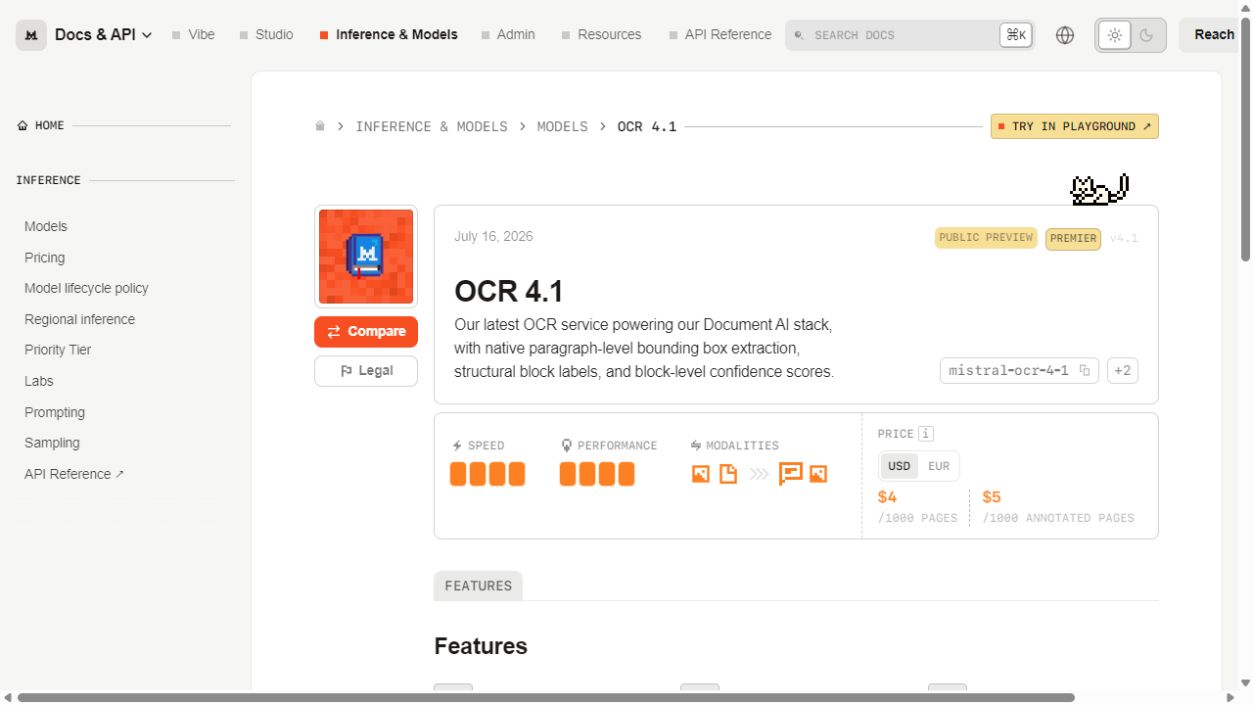
OCR status — August 26, 2026: Mistral OCR 4.1 is the latest documented OCR service and remains in Public Preview. It retains paragraph-level bounding boxes and structural block labels and adds block-level confidence scores. The aliases
mistral-ocr-latestandmistral-ocr-4now point to 4.1. OCR 4.0 remains separately listed; the reviewed sources do not establish that it is retired.
Short answer: start with MiniMax when million-token context or an integrated text, video, speech, image, and music model catalog is central to the product. For a new integration, do not assume hosted Music API access: from August 20, 2026 it is closed to new users, while eligible existing paying users may continue. Start with Mistral when you need permissively licensed Apache 2.0 weights, a choice of model sizes, document intelligence, configurable enterprise deployment, or publicly documented API privacy controls. For coding agents and general multimodal applications, test MiniMax M3 against Mistral Medium 3.5 and Mistral Small 4 on your own repository and tools.
Independent comparison notice: MiniMax-AI.chat is an independent publication. It is not MiniMax or Mistral AI and is not affiliated with or endorsed by either company. This guide separates provider products, hosted APIs, and downloadable weights. It uses official documentation available on the verification date and does not treat vendor benchmarks as neutral proof that one model is universally better.
Important 2026 update: older comparisons built around MiniMax M2.x, Mistral Medium 3, Mistral Small 3.x, or Devstral 2 are no longer suitable as a default buying guide. MiniMax now lists M3 as its latest M-series language model and Music 3.0 as its current music model. Mistral lists Medium 3.5 and Small 4 as featured models, and its model catalog marks Devstral 2 as deprecated with Medium 3.5 as the alternative.
MiniMax AI vs Mistral AI Comparison Contents
- Quick verdict by workflow
- Methodology and scope
- Products, APIs, and weights
- Current model lineups
- Context and modalities
- Coding and agents
- API and developer experience
- Media, documents, OCR, and speech
- Open weights, licenses, and self-hosting
- API and product pricing
- Privacy, data controls, and governance
- Recommendations by use case
- How to evaluate both platforms
- Final verdict
- FAQ
- Official sources
Quick Verdict: MiniMax or Mistral?
| Your main requirement | Better starting point | Why | Check before committing |
|---|---|---|---|
| Maximum documented hosted context | MiniMax M3 | MiniMax documents a 1,000,000-token context window; the compared current Mistral generalists document 256k | Test retrieval quality, latency, and price with your real long inputs |
| Apache 2.0 downloadable weights | Mistral | Mistral Large 3, Mistral Small 4, and the Ministral 3 family have model-specific Apache 2.0 releases | Confirm the exact repository and license; not every Mistral model uses Apache 2.0 |
| Long-context coding agent | Test both | M3 emphasizes long-horizon coding and tool use; Medium 3.5 powers Mistral’s current Vibe remote agents | Measure successful issue completion, not vendor benchmark scores |
| Low-cost current generalist API | Compare M3 and Small 4 | Mistral Small 4 has lower listed token rates; M3 supplies more context at its standard tier | Include reasoning tokens, retries, cache behavior, and output length |
| Text plus native video, speech, image, and music APIs | MiniMax | MiniMax documents H3 through Video Generation V2 plus Speech and Image-01 endpoints; Music 3.0 hosted access is retained only for eligible existing paying users | These are separate models and charges; M3 itself does not output video, audio, or music, and legacy Hailuo limits and prices do not describe H3 V2 |
| OCR and structured document ingestion | Mistral | OCR 4.1 is a dedicated document service with bounding boxes, structural block labels, and page pricing | Validate layout fidelity, tables, handwriting, language coverage, and human-review needs |
| Small or edge-oriented open models | Mistral | Mistral provides several model sizes, including Ministral releases and specialist open models | Hardware requirements and output quality vary substantially by size and quantization |
| Explicit hosted API privacy controls | Mistral is easier to assess publicly | Mistral documents training treatment, retention controls, Labs-model exceptions, and GDPR controls | Confirm contractual terms, region, endpoints, subprocessors, and zero-retention eligibility |
| Self-host the exact flagship being evaluated | Both offer weights | M3, Medium 3.5, Small 4, and Large 3 have official weight releases | Model licenses, hardware, inference software, safety, and support obligations differ |
How This Comparison Was Made
A fair MiniMax vs Mistral comparison must keep three different layers separate:
- User products: MiniMax Agent and MiniMax Code on one side; Mistral Vibe, Vibe for Code, and Work mode on the other. Subscription access and product limits do not automatically transfer to an API account.
- Hosted developer platforms: MiniMax Open Platform and Mistral Studio/API. Each has its own model IDs, token billing, tools, rate limits, data controls, and service terms.
- Downloadable weights: MiniMax M3 and selected Mistral models can be deployed outside the providers’ hosted APIs. Weight availability does not mean that all related product features, tools, moderation, or managed services are included.
This page uses current official model catalogs, model cards, launch posts, pricing pages, release notes, privacy documentation, and model licenses. It deliberately avoids a provider benchmark winner table. Benchmark results can change with prompts, reasoning settings, tool scaffolds, context, compute, and grading. The useful question is whether a particular model completes your real task accurately, quickly, and economically under your operating constraints.
Prices are listed in US dollars exactly as published for the named model or plan on July 17, 2026, before taxes and negotiated enterprise terms. A floating alias such as latest can move to a newer model. Pin a version where repeatability matters, and re-check the provider console before estimating production cost.
What MiniMax AI and Mistral AI Actually Include
| Layer | MiniMax ecosystem | Mistral ecosystem |
|---|---|---|
| Work and chat product | MiniMax Agent, currently branded around Mavis and Agent Teams | Mistral Vibe for work and chat, including plan-dependent Work and connector capabilities |
| Coding product | MiniMax Code 2.0, CLI and third-party tool integrations powered by M3 | Vibe for Code in terminal, IDE, web, and remote-agent workflows |
| Developer console/API | MiniMax Open Platform with language, video, speech, image, music, file, MCP, and server-tool documentation | Mistral Studio/API with chat, agents, conversations, tools, structured output, OCR, audio, embeddings, moderation, and batch features |
| Current language focus | MiniMax M3, with M2.7 still available and older M2 models listed separately | Medium 3.5 and Small 4 as featured models, plus Large 3, Ministral 3, and specialist families |
| Document intelligence | M3 multimodal input and file workflows; document pipelines must be assembled around available APIs | Dedicated OCR 4.1 and Document AI, plus document Q&A and retrieval tooling |
| Generative media | MiniMax-H3 video — current; Hailuo 2.3 / 2.3 Fast / 02 — legacy; Speech 2.8 and Image-01; Music 3.0, Music 2.6, and music-cover only for eligible existing paying hosted-API users | Speech input/output models and product image generation; current API catalog does not present a direct native music or text-to-video family equivalent to MiniMax’s dedicated endpoints |
| Open weights | M3 under the MiniMax Community License | Multiple families under model-specific licenses, including Apache 2.0 and Modified MIT releases |
| Enterprise deployment | Hosted API plus M3 local deployment guidance; enterprise conditions require direct verification | Mistral cloud, cloud partners, and self-hosted/private/on-premises offerings depending on product and contract |
This map prevents two common mistakes. First, M3’s multimodal input does not mean the language model generates a finished H3 video or Music 3.0 song; those are separate models and API calls. Second, a Mistral model’s open weights do not automatically include the Vibe remote-agent runtime, Studio tools, OCR service, support, or hosted data controls.
Current MiniMax and Mistral Model Lineups
MiniMax’s Current Language and Media Models
MiniMax M3 is the current centerpiece. MiniMax describes it as a frontier multimodal coding model for agentic reasoning, tool use, and long-context work. Its official model card lists approximately 428 billion total parameters, about 23 billion activated parameters, native text/image/video understanding, and a one-million-token context window. The hosted API also lists M2.7 and M2.7-highspeed, while M2.5, M2.1, and M2 appear in the legacy section of current pricing documentation.
MiniMax’s current catalog extends beyond language models. MiniMax H3 is the current video model, using Video Generation V2 for text-to-video, first/last-frame image-to-video, and multimodal reference-to-video. It outputs 768P or 2K video for an integer 4–15 seconds at 24 fps. The same catalog places Hailuo 2.3, Hailuo 2.3 Fast, and Hailuo 02 under Legacy Models. Speech 2.8 HD and Turbo cover text-to-speech; Image-01 covers image generation; and Music 3.0 is the current recommended music-generation model. Music 2.6 remains listed, while Music 2.0 is a legacy model. See the dedicated MiniMax Music 3.0 guide rather than treating an older Music 2.6 review as the current product description.
Mistral’s Current Generalist and Specialist Models
| Mistral model | Official positioning | Context | Weight/license note |
|---|---|---|---|
| Mistral Medium 3.5 | Frontier-class multimodal model optimized for agentic and coding work; powers current Vibe remote agents | 256k | Open weights under a Modified MIT license |
| Mistral Small 4 | Hybrid instruct, reasoning, multimodal, and agentic-coding model with configurable reasoning effort | 256k | Apache 2.0; 119B total parameters with the model card reporting about 6.5B active |
| Mistral Large 3 | General-purpose multimodal mixture-of-experts model | 256k | Apache 2.0; 675B total and 41B active parameters |
| Ministral 3 | 3B, 8B, and 14B families for smaller and local deployment scenarios, with text and vision variants | Check the exact model card | Mistral’s launch says the family was released under Apache 2.0 |
| OCR 4.1 | Document extraction with paragraph bounding boxes and structural block labels | Page-based service | Premier hosted service; enterprise self-managed availability is separate |
| Voxtral models | Transcription, realtime speech input, audio understanding, and text-to-speech depending on model | Model-specific | Open or Premier labels vary by model |
Do not select Devstral 2 simply because older articles call it Mistral’s newest code-agent model. The current Mistral model overview marks devstral-2512 as deprecated, gives July 31, 2026 as its retirement date, and names Medium 3.5 as the replacement. For new coding work, evaluate Medium 3.5 and Small 4 first unless a pinned legacy integration gives you a documented reason to do otherwise.
Context Windows and Multimodal Input
MiniMax M3 has the larger documented context window in this specific comparison: 1,000,000 tokens versus 256k for Mistral Medium 3.5, Small 4, and Large 3. That extra capacity can help when a single request must include a large repository, long video, extensive document set, or lengthy agent history. It does not guarantee that the model will retrieve every detail correctly, and it can increase latency and billing.
| Capability | MiniMax M3 | Current Mistral generalists | Practical meaning |
|---|---|---|---|
| Text input | Yes | Yes | Suitable for chat, extraction, generation, coding, and agent prompts |
| Image input | Yes | Yes for Medium 3.5, Small 4, and Large 3 | Test image size, document layout, chart reading, and supported request format |
| Video input | Documented through M3’s OpenAI-compatible multimodal input | No equivalent video-input claim is made on the compared current model cards | MiniMax is the clearer documented starting point for video-aware language analysis |
| Language-model output | Text/reasoning/tool calls | Text/reasoning/tool calls | Use specialist endpoints for audio, image, video, or music assets |
| Maximum listed context | 1,000,000 | 256k for the three named generalists | Context size is capacity, not an accuracy or memory guarantee |
Use a controlled long-context test. Insert known facts at the beginning, middle, and end of your input; ask questions that require combining distant sections; repeat the run; and grade citations back to source locations. Compare that with a retrieval-augmented version using smaller chunks. A million-token prompt can be convenient, but retrieval may still be more reliable and economical for a production knowledge system.
Coding and Agent Workflows
MiniMax M3, Mavis, and MiniMax Code
M3 is designed for agentic reasoning, tool invocation, coding, and structured multi-step tasks. MiniMax exposes Anthropic-compatible and OpenAI-compatible language-model routes, which can reduce migration work for tools already built around those SDK conventions. MiniMax Agent adds a user-facing multi-agent workflow, while MiniMax Code targets software work. Read the current MiniMax Agent guide and MiniMax Code guide for product-level availability rather than inferring a product feature from the base model alone.
MiniMax desktop availability: Version 3.0.46 historically recorded a temporary Computer Use disablement and retired the standalone
deep-researchskill, requiring explicit/teaminvocation for that desktop research workflow. MiniMax Code v3.0.54 added Browser Control inside its built-in browser, including reading pages, filling forms, uploading workspace files, and checking results. The changelog does not explicitly confirm that broader system-wide Computer Use has returned. Check the current desktop version before treating M3’s model-level capability as a product-surface guarantee.
The one-million-token context is potentially useful for repository-scale tasks, but agent quality still depends on file discovery, shell and tool permissions, patch discipline, tests, recovery from failed commands, and human review. A long context window cannot replace a correct execution harness.
Mistral Medium 3.5, Small 4, and Vibe
Mistral Medium 3.5 is the current default model behind Vibe remote agents according to Mistral’s May 2026 announcement. It is a dense 128B multimodal model with configurable reasoning, structured-output support, and a 256k context window. Mistral says Vibe can run isolated remote coding sessions, show file diffs and tool calls, continue asynchronously, open pull requests, and integrate with engineering tools. These are Vibe product capabilities, not properties automatically included when you download the Medium 3.5 weights.
Small 4 combines instruct, reasoning, image input, and coding-agent capabilities in an Apache 2.0 release. It can be attractive when a team needs a lower hosted token price or more control over self-deployment. Medium 3.5 is the clearer official starting point for Mistral’s hosted long-horizon coding experience, while Small 4 is a useful efficiency and deployment candidate.
| Coding decision | Recommended test |
|---|---|
| Very large repository prompt | Test M3’s longer context against Medium 3.5 with retrieval and repository tools |
| Hosted remote coding agent | Compare MiniMax Code/Agent behavior with Vibe remote sessions using the same issues and approval policy |
| Commercial self-hosted agent | Compare Mistral Small 4 or Large 3 Apache 2.0 terms with M3’s Community License and your hardware budget |
| Low-cost high-volume code transformation | Measure cost per accepted patch using M3 and Small 4, including failed runs and reviewer time |
| Regulated source code | Assess private deployment, retention, auditability, regional processing, access controls, and contractual commitments |
API and Developer Experience
MiniMax’s language API supports an Anthropic-compatible base URL at https://api.minimax.io/anthropic and an OpenAI-compatible base URL at https://api.minimax.io/v1. The Anthropic-compatible route is the recommended path in MiniMax documentation for thinking blocks and interleaved thinking. The OpenAI-compatible route supports text, image, and video content parts for M3. MiniMax also documents prompt caching, tool use, server-side web search, files, and separate multimodal-generation APIs.
Mistral’s developer platform exposes chat completions, function calling, agents and conversations, built-in tools, structured and predicted outputs, OCR, document Q&A, fill-in-the-middle, embeddings, moderation, transcription, text-to-speech, timestamps, and batch processing depending on the selected model and endpoint. Studio is the console for API keys, the playground, evaluations, agents, and SDK-based development.
| Developer concern | MiniMax | Mistral |
|---|---|---|
| Migration compatibility | Documented Anthropic-style and OpenAI-style LLM routes | Native Mistral API and SDK ecosystem; integration changes depend on your current client |
| Tool and agent primitives | Tool use, interleaved thinking, server tools, Agent products, MCP-related resources | Agents, conversations, built-in/custom tools, workflows, connectors, and structured output |
| Multimodal input | M3 supports text, image, and video input through current OpenAI-compatible guidance | Featured generalists support text and image; audio/document capabilities also have specialist models |
| Batch/caching economics | M3 pricing lists prompt-cache read rates and service tiers | Mistral advertises 50% batch discounts and up to 90% savings for cached input on its pricing page |
| Version stability | Use exact MiniMax model IDs and monitor release notes | Pin a version rather than relying only on a moving latest alias; monitor deprecation dates |
Neither compatibility nor a short SDK example proves production interchangeability. Test error objects, streaming events, tool-call schemas, structured-output validation, timeouts, retry headers, rate limits, safety responses, token accounting, and model deprecations. Read the full MiniMax API guide before copying an older chatcompletion_v2 example, because MiniMax now marks that older endpoint deprecated and documents current compatible routes separately.
Video, Music, Images, OCR, and Speech
The platforms’ specialist strengths are more different than their language-model capabilities.
| Workload | MiniMax option | Mistral option | Editorial assessment |
|---|---|---|---|
| Text/image/multimodal-reference-to-video | MiniMax-H3 via Video Generation V2; Hailuo 2.3-series models are legacy | No direct current native video-generation family shown in the checked Mistral model catalog | MiniMax is the documented starting point between these platforms; compare H3, not a legacy Hailuo route, for a new integration |
| Song generation | Music 3.0, Music 2.6, and music-cover for eligible existing paying API users; free API variants discontinued August 20, 2026 | No direct current music-generation model shown in the checked Mistral catalog | MiniMax provides the model family, but new users cannot activate the hosted Music API |
| Image generation | Image-01 API | Image creation is included in Vibe plan descriptions, but it is not the same as Mistral’s open-weight language models | Check whether you need a developer image API, a product feature, or a self-hosted model |
| Text-to-speech | Speech 2.8 HD and Turbo, plus voice cloning/design services | Voxtral TTS | Compare language, voice rights, latency, streaming, cloning controls, and price on your exact script |
| Realtime transcription | Review MiniMax’s current audio catalog for supported speech workflows | Voxtral Mini Transcribe Realtime is listed at $0.006 per minute | Mistral has a clearly documented specialist realtime model |
| OCR/document parsing | M3/file pipelines can analyze content, but no equivalent page-priced OCR 4.1 service is listed | OCR 4.1 with bounding boxes, structural labels, and annotated-page output | Mistral is the clearer document-ingestion specialist |
Creative output requires more than technical capability. Verify input rights, voice consent, likeness permissions, disclosure or watermark requirements, commercial-use terms, and the provider’s current content policy. A generated asset being technically downloadable does not by itself establish exclusive ownership or freedom from third-party rights.
Open Weights, Licenses, and Self-Hosting
Both companies publish weights, but “open-weight” is not a single legal category. Read the license attached to the exact repository and version. Do not copy a licensing statement from one model family to another.
| Model | Published license | Commercial-deployment implication |
|---|---|---|
| MiniMax M3 | MiniMax Community License | Commercial use includes attribution/notice conditions and a separate authorization threshold; legal review is appropriate |
| Mistral Large 3 | Apache 2.0 | Permissive model-specific release, subject to the license and applicable law |
| Mistral Small 4 | Apache 2.0 | Permissive release suitable for customization and self-deployment under its terms |
| Mistral Medium 3.5 | Modified MIT | Not the same license as Small 4 or Large 3; review the modification before production use |
| Other Mistral models | Model-specific | Never assume that the company name or an “Open” badge guarantees Apache 2.0 |
The M3 license grants non-commercial use and defines additional commercial-use conditions. It requires a prominent “Built with MiniMax M3” display for commercial products or services. It also requires a one-time notice to MiniMax for covered commercial use below the stated revenue threshold and prior written authorization when products or services generate more than US$20 million in yearly revenue. The license also contains prohibited-use clauses. This summary is not legal advice; use the linked license text for the exact obligations.
Mistral’s Apache 2.0 releases are operationally simpler for many commercial teams, but self-hosting is not free or automatic. Large 3 is a 675B-total-parameter mixture-of-experts model, and even optimized deployment requires substantial hardware. Small 4 is more efficient but still has published enterprise-grade infrastructure requirements. Model weights also leave your team responsible for inference security, scaling, observability, safety controls, updates, and incident response.
MiniMax vs Mistral API Pricing
The table below compares named current models, not consumer chat subscriptions. Input and output prices are per one million tokens. Provider rates can change; verify the official pages and your console before launch.
| Hosted model/tier | Input | Output | Context/pricing note |
|---|---|---|---|
| MiniMax M3 Standard, input ≤512k | $0.30/M | $1.20/M | Prompt-cache read $0.06/M; official page labels the shown rate a permanent 50% discount |
| MiniMax M3 Standard, input >512k | $0.60/M | $2.40/M | Prompt-cache read $0.12/M |
| MiniMax M3 Priority, input ≤512k | $0.45/M | $1.80/M | Priority is listed at 1.5× Standard for admission and reliability |
| MiniMax M3 Priority, input >512k | $0.90/M | $3.60/M | Use the selected service tier in cost estimates |
| Mistral Small 4 | $0.15/M | $0.60/M | 256k context on its versioned model card |
| Mistral Large 3 | $0.50/M | $1.50/M | 256k context on its versioned model card |
| Mistral Medium 3.5 | $1.50/M | $7.50/M | 256k context; current agentic/coding focus |
Small 4 has the lowest listed raw token rates in this table. That does not make it the cheapest completed workflow. A model that produces more tokens, needs repeated calls, fails tool use, or requires more human correction can cost more than a higher-rate model. Conversely, M3’s long context can reduce retrieval engineering in some tasks but moves to the higher standard price once input exceeds 512k.
Specialist and Product Pricing
- MiniMax Music 3.0 hosted API: $0.15 per up to 5 minutes remains the listed price for eligible existing paying users. From August 20, 2026, the paid Music and Lyrics APIs are unavailable to new users and the free API model IDs are discontinued.
- MiniMax image-01: $0.0035 per image.
- MiniMax Speech 2.8: $60 per million characters for Turbo and $100 per million characters for HD, with separate voice-cloning and voice-design charges.
- MiniMax video: H3 output is listed at $0.08 per second for 768P and $0.13 per second for 2K. Reference video and additional reference images can add input charges; Hailuo 2.3-series clip prices appear under Legacy Models. H3 V2 is the pay-as-you-go route. Use the current MiniMax pricing guide.
- Mistral OCR 4.1: $4 per 1,000 pages or $5 per 1,000 annotated pages on the current model card.
- Voxtral Mini Transcribe Realtime: $0.006 per minute on the current model card.
Mistral Vibe subscriptions are separate from API token billing. The public pricing page lists Free, Pro at $14.99 per month, Team at $24.99 per user per month, and Enterprise by sales contact, subject to fair-use limits and taxes. Do not compare a Vibe subscription directly with MiniMax API pay-as-you-go or Token Plan quotas as if they purchase the same resources.
Privacy, Data Controls, and Enterprise Governance
Mistral publishes relatively detailed product-level privacy controls. Its current documentation says Vibe Free conversations can be used to improve models with an opt-out, while Pro, Team, and Enterprise conversations are not used for training by default. It says API data is not used for model training, describes configurable chat-retention periods, and documents a zero-data-retention control for troubleshooting and analytics data. It also warns that enabling Labs models can allow data use for training regardless of ordinary opt-out settings under the commercial terms.
Mistral’s website says its hosted Mistral cloud servers are in the EU and also offers cloud-partner and self-hosted deployment paths. That statement should not be expanded into a blanket guarantee about every endpoint, connector, subprocessor, or customer configuration. Regulated buyers should confirm data location, transfers, support access, encryption, retention, backups, incident notice, and deletion in the applicable contract and data-processing agreement.
MiniMax publishes platform terms and a privacy policy, but the public documentation reviewed for this comparison does not present the same detailed control matrix for API training, zero retention, and regional processing. That does not prove weaker internal protection; it means a buyer has less public evidence to rely on. Ask MiniMax for written answers and contractual commitments before sending health, legal, financial, confidential, personal, or security-sensitive data. See this site’s independent MiniMax privacy guide for a source-by-source reading.
| Enterprise question | What to obtain before launch |
|---|---|
| Is API data used for training? | Product-specific written terms, including exceptions for preview/Labs models, feedback, abuse review, and support |
| How long is content retained? | Prompt, output, file, log, backup, troubleshooting, and deletion schedules |
| Where is data processed? | Endpoint region, storage region, subprocessors, cross-border transfer mechanism, and failover behavior |
| Can we self-host? | Model license, hardware estimate, security architecture, updates, support, and incident responsibilities |
| What can administrators audit? | SSO, access roles, workspace boundaries, usage logs, export, retention policy, and audit-log detail |
| Is it approved for regulated data? | Applicable certifications, signed agreements, technical controls, risk assessment, and legal approval—not marketing language |
Which Platform Should You Choose?
Choose MiniMax as Your Starting Point If…
- You need a documented one-million-token context window in a current hosted model.
- Your application analyzes video as input to an LLM or combines language work with current MiniMax-H3 video generation.
- You want video, speech, image, and music generation in one provider’s documented API catalog.
- You already use an Anthropic-style or OpenAI-style client and want a compatible MiniMax route.
- You want to evaluate M3 weights and can comply with the MiniMax Community License.
- Your coding or agent task benefits from long repository context and you are prepared to test the execution harness carefully.
Choose Mistral as Your Starting Point If…
- You need an Apache 2.0 current model such as Small 4 or Large 3.
- You want several deployment sizes and stronger edge/local model options rather than one very large flagship.
- You are building OCR, document extraction, RAG ingestion, transcription, or speech workflows around specialist models.
- You need a hosted remote coding product and want to evaluate Vibe with Medium 3.5.
- You need publicly documented training, retention, Labs-model, GDPR, and administrative privacy controls.
- You want Mistral cloud, cloud-partner, private, or on-premises paths available for enterprise evaluation.
Use Both When the Workflow Is Naturally Split
A mixed architecture can be sensible. Mistral OCR 4.1 can ingest complex documents, a self-hosted Small 4 deployment can handle sensitive classification, MiniMax M3 can process exceptionally long multimodal context, and MiniMax’s specialist APIs can produce video, voice, image, or music assets. The trade-off is additional vendor management, observability, data transfer, fallback logic, and policy review. Use a routing layer only when measured gains justify that complexity.
A Practical Evaluation Plan
Run the same evaluation set through the exact model versions and service tiers you might deploy. Twenty to fifty representative tasks are more informative than one polished demo.
- Define success first. Write objective acceptance criteria for correctness, required citations, file changes, output format, and prohibited behavior.
- Use production-like inputs. Include your real languages, document layouts, repository size, media, tools, and edge cases after removing data you are not authorized to upload.
- Pin model IDs and settings. Record reasoning mode, temperature, context size, service tier, tools, system prompt, and date.
- Measure completed-task economics. Count input, output, cache, tool, OCR, media, retries, failed jobs, and human-review time.
- Test long context explicitly. Place facts throughout the input and verify retrieval against exact source locations.
- Test agents in a sandbox. Limit credentials and network access, require approval for consequential actions, and run automated tests before accepting changes.
- Review legal and privacy terms. Match the precise hosted product or weight license to your commercial and data-processing use.
- Plan for deprecations. Monitor release notes, pin versions where possible, and maintain a tested fallback before a model retirement date.
A useful scorecard includes task completion rate, factual error rate, citation accuracy, tool-call success, schema-valid output rate, latency percentiles, input/output tokens, retries, human correction minutes, safety incidents, and total cost per accepted result. Those numbers are more valuable than declaring a benchmark champion.
Final Verdict
MiniMax AI is the more distinctive choice for million-token M3 workflows and for teams that want one documented ecosystem spanning language, video, speech, image, and the Music 3.0 model family; new users cannot activate its hosted Music API. M3’s compatible API routes, multimodal video input, coding focus, and downloadable weights make it a serious candidate for long-context agents and media-rich products. Its Community License and less explicit public API governance controls require careful review for commercial or regulated deployments.
Mistral AI is the more flexible choice for open-weight portfolios, model-size selection, Apache 2.0 deployment, document intelligence, speech processing, and enterprise infrastructure. Medium 3.5 is the current coding-agent model to evaluate, Small 4 offers a lower-cost Apache 2.0 hybrid, Large 3 provides a larger open generalist, and OCR 4.1 gives the platform a clear specialist document path. Mistral also publishes a more detailed privacy-control framework for its hosted products.
There is no defensible universal winner. Choose MiniMax when long context and generative media are product requirements. Choose Mistral when licensing, deployment control, model variety, OCR, or public governance documentation dominate. Benchmark both for coding and general multimodal work, because your prompts, tools, data, latency target, and reviewer standards will decide the production result.
MiniMax AI vs Mistral AI FAQ
Is MiniMax AI better than Mistral AI?
Not universally. MiniMax is the stronger documented starting point for one-million-token M3 context and a platform combining language with dedicated video, speech, image, and music APIs. Mistral is the stronger starting point for Apache 2.0 weights, model-size variety, OCR, self-hosting choices, and publicly documented API privacy controls.
Which is better for coding agents?
Test MiniMax M3 against Mistral Medium 3.5 and Small 4. M3 provides more documented context and MiniMax-compatible coding/agent paths. Medium 3.5 powers Mistral’s current Vibe remote agents, while Small 4 offers Apache 2.0 weights and lower listed token rates. Do not use Devstral 2 as the default for a new integration because Mistral marks it deprecated and points to Medium 3.5.
Which has the larger context window?
MiniMax M3. Its hosted documentation lists 1,000,000 tokens. Mistral Medium 3.5, Small 4, and Large 3 each list 256k. Context length is capacity, not a guarantee of retrieval accuracy, and M3’s token pricing changes when input exceeds 512k.
Is MiniMax or Mistral cheaper?
It depends on the selected model and task. Mistral Small 4 lists $0.15 per million input tokens and $0.60 per million output tokens, below M3 Standard’s $0.30 and $1.20 rates for input up to 512k. Mistral Medium 3.5 is higher at $1.50 and $7.50. Compare total cost per accepted task, including retries, reasoning output, caching, tools, media, and human review.
Are MiniMax and Mistral open source?
Selected models have downloadable weights, but the licenses differ. Mistral Large 3 and Small 4 are Apache 2.0 releases; Medium 3.5 uses a Modified MIT license. MiniMax M3 uses the MiniMax Community License with commercial-use conditions. Use “open-weight” when describing availability generally, then name the exact license.
Can I self-host MiniMax M3 or Mistral models?
Yes, selected weights from both providers can be deployed on your infrastructure. M3’s model card documents frameworks including SGLang, vLLM, Transformers, KTransformers, and Unsloth. Mistral publishes deployment guidance for its open models. Hardware requirements can be substantial, and you remain responsible for licensing, scaling, safety, security, and updates.
Which is better for video and music generation?
MiniMax is the relevant documented choice between these platforms. Its current video model is MiniMax H3 through Video Generation V2, alongside Music 3.0 as a separate endpoint only for eligible existing paying users. Hailuo 2.3-series API models are legacy. The current Mistral model catalog checked August 13, 2026 does not show a direct native text-to-video or music-generation family equivalent.
Which is better for OCR and document extraction?
Mistral has the clearer specialist offering. OCR 4.1 retains paragraph-level bounding boxes and structural block labels, adds block-level confidence scores, supports annotated outputs, and keeps per-page pricing. It is Public Preview, and OCR 4.0 remains separately listed. M3 can understand images and files as part of broader multimodal workflows, but that is not the same as a dedicated document-ingestion service.
Which has better privacy documentation?
Mistral publishes more explicit controls in the documentation reviewed: product-specific training treatment, chat retention choices, an API zero-retention control, Labs-model exceptions, and GDPR rights. MiniMax publishes platform terms and privacy policy, but buyers should obtain written product-specific answers for retention, training, regional processing, and enterprise controls before sensitive use.
What is MiniMax’s current music model?
Music 3.0 is the current model added on July 16, 2026. MiniMax also lists Music 2.6 and music-cover, while Music 2.0 is in the legacy section. Comparisons that still present Music 2.6 as MiniMax’s newest music model need updating.
Are MiniMax Agent and Mistral Vibe included with API access?
Do not assume so. They are user-facing products with their own plans, limits, rollouts, and terms. API keys and pay-as-you-go billing are separate developer access paths. Confirm the purchased plan and resource coverage for each product.
Official Sources
Primary sources checked for this update:
- MiniMax model catalog
- MiniMax language-model invocation guide
- MiniMax pay-as-you-go pricing
- MiniMax model release notes
- Official MiniMax M3 model card
- MiniMax M3 Community License
- MiniMax API Platform Privacy Policy
- Mistral models overview and deprecations
- Mistral Medium 3.5 model card
- Mistral Small 4 model card
- Mistral Large 3 model card
- Mistral Medium 3.5 and Vibe remote-agent announcement
- Mistral Small 4 announcement
- Mistral 3 and Apache 2.0 release announcement
- Mistral OCR 4.1 model card
- Voxtral Mini Transcribe Realtime model card
- Mistral product and API pricing
- Mistral privacy and data controls
Independence disclosure: Model catalogs, aliases, prices, limits, licenses, and product availability can change. Verify the linked official source, the exact model ID, and your contract before making a production, legal, privacy, or purchasing decision.