

Last verified: October 21, 2026
MiniMax M3.1 Flash is MiniMax’s newest M-series language model, released on October 19, 2026. MiniMax’s release notes describe it in one line: “An ultra-efficient open-weight model for everyday work.” Its API name is MiniMax-M3.1-Flash, and it costs $0.15 per million input tokens and $0.60 per million output tokens, with no extra charge for long prompts.
The model first shipped on September 27, 2026 as M3.1-Flash-Preview, a subscription-only test release inside MiniMax Code. The full release replaces that preview. It is now available on the pay-as-you-go API, in every M Plan tier, and in MiniMax Code. MiniMax has also published its first benchmark scores for it and says the model weights “will be released later.”
- Price: $0.15 input, $0.60 output, and $0.015 cached input per 1M tokens, flat at every prompt length.
- Context: 1,000,000 tokens, with text, image, and video input.
- Reasoning: always on, with five effort levels from
lowtomax(defaultmax). - MiniMax-reported results: 73.7 on DeepSWE v1.1, 62.8 on Automation-Bench v1.0.6, 61.7 on OSWorld 2.0, 82.2 on CyberGym, and output speeds of 200+ tokens per second.
- Open weights: announced but not yet published on Hugging Face when this page was last verified.
What MiniMax has published about M3.1 Flash
| Item | Official detail | Source |
|---|---|---|
| Model name | MiniMax-M3.1-Flash | Text-generation guide |
| Release date | October 19, 2026 | Model release notes and announcement |
| Description | “An ultra-efficient open-weight model for everyday work”; “frontier multimodal coding model with 1M context window and tunable thinking depth” | Release notes; model catalog |
| Context window | 1,000,000 tokens | Text-generation guide |
| Inputs | Text, images, and video | Text-generation guide |
| Thinking | Always on; effort of low, medium, high, xhigh, or max; default max | Text-generation guide |
| Pay-as-you-go price | $0.15 input / $0.60 output / $0.015 cache read per 1M tokens | Pay-as-you-go price list |
| Access | MiniMax API, M Plan, and MiniMax Code | Announcement |
| API rate limit | 200 requests per minute and 10,000,000 tokens per minute (listed together with M3) | Rate-limit page |
| Speed | Output “can reach 200+ TPS,” with median (P50) speeds of “170+ TPS” | Announcement (MiniMax-reported) |
| Open weights | “Model weights will be released later” | Announcement |
MiniMax has not published a parameter count, an architecture breakdown, or a model card for M3.1 Flash. If you see specific parameter figures quoted for it, they did not come from MiniMax’s own pages. MiniMax did reveal one piece of history: its announcement says “Space Bunny,” an anonymous model that processed more than 200 trillion tokens before launch, “was an early version of MiniMax M3.1 Flash.”
MiniMax M3.1 Flash pricing, with a cost comparison against M3
The headline is a flat price. M3 charges more once a request carries over 512K input tokens; M3.1 Flash has a single row on MiniMax’s pay-as-you-go price list.
| Price per 1M tokens | MiniMax M3.1 Flash | MiniMax M3 (Standard, ≤512K input) | MiniMax M3 (Standard, >512K input) |
|---|---|---|---|
| Input | $0.15 | $0.30 | $0.60 |
| Output | $0.60 | $1.20 | $2.40 |
| Cache read | $0.015 | $0.06 | $0.12 |
Worked example 1: a coding-agent session
Say an agent makes 20 calls. Each call sends 50,000 input tokens, of which 40,000 are a repeated prefix served from the prompt cache, and returns 2,500 output tokens. Over the session that is 200,000 uncached input tokens, 800,000 cache-read tokens, and 50,000 output tokens.
M3.1 Flash: 200,000 × $0.15/M + 800,000 × $0.015/M + 50,000 × $0.60/M
          = $0.030 + $0.012 + $0.030 = $0.072

M3 (≤512K): 200,000 × $0.30/M + 800,000 × $0.06/M + 50,000 × $1.20/M
          = $0.060 + $0.048 + $0.060 = $0.168
The same session costs about 57% less on M3.1 Flash, because the cache-read rate is a quarter of M3’s and the other two rates are half.
Worked example 2: one very long prompt
A single request with 700,000 input tokens (a large codebase or document set) and 10,000 output tokens crosses M3’s 512K threshold:
M3.1 Flash: 700,000 × $0.15/M + 10,000 × $0.60/M = $0.105 + $0.006 = $0.111
M3 (>512K): 700,000 × $0.60/M + 10,000 × $2.40/M = $0.420 + $0.024 = $0.444
Here M3.1 Flash is about a quarter of the cost. MiniMax’s own claim is broader: it says that for agentic tasks, overall usage cost is “70% lower than its predecessor.” Real bills depend on retries, tool loops, and how much of each prompt hits the cache, so measure your own workload before you budget. Every other MiniMax rate is in our MiniMax pricing guide.
Three ways to use M3.1 Flash
MiniMax’s announcement says M3.1 Flash “is now available through the MiniMax API, M Plan, and MiniMax Code.” Pick the route that matches how you pay and work.
| Route | How you pay | Key you use | Best for |
|---|---|---|---|
| MiniMax API (pay-as-you-go) | Per token, from your Open Platform balance | Standard API key | Production apps, automation, and metered billing |
| M Plan | Monthly or yearly subscription | Subscription Key | Coding agents and AI tools you use interactively |
| MiniMax Code | Included with M Plan; a Free tier lists limited M3.1 Flash use | None; sign in | MiniMax’s own agent app on web, desktop, terminal, and mobile |
On the API
Use the Anthropic-compatible base URL https://api.minimax.io/anthropic, which MiniMax recommends, or the OpenAI-compatible https://api.minimax.io/v1. This request follows MiniMax’s documented format:
curl https://api.minimax.io/anthropic/v1/messages \
  -H "Authorization: Bearer $MINIMAX_API_KEY" \
  -H "Content-Type: application/json" \
  -d '{
    "model": "MiniMax-M3.1-Flash",
    "output_config": {"effort": "medium"},
    "max_tokens": 4096,
    "messages": [{"role": "user", "content": "Summarize the failing tests in this log: ..."}]
  }'
On the OpenAI-compatible Chat Completions route, set reasoning_effort instead. Thinking comes back in reasoning_content, separate from the answer. Keep keys on the server. Our API key and base URL guide covers regional endpoints and authentication errors.
In M Plan
All three M Plan tiers list “Text models, e.g., M3.1 Flash”: Go ($22 a month), Explore ($55), and Build ($132). The plan bills a shared usage allowance rather than tokens, and your Subscription Key plugs into Claude Code, Cursor, Codex, and other compatible tools. Our MiniMax M Plan guide explains tiers, windows, and Credits.
In MiniMax Code
MiniMax Code, MiniMax’s own agent app, shows M3.1-Flash in its model selector, and an M Plan subscription unlocks it without a separate key. See our MiniMax Code guide for downloads and setup.
Moving from the preview: MiniMax says MiniMax-M3.1-Flash-Preview “has been retired. Requests using the old name are now served by MiniMax-M3.1-Flash.” Existing integrations keep working, but update the model ID in your configuration so logs and cost reports match.
Context window and the five effort levels
M3.1 Flash supports a 1,000,000-token context “for long documents, codebases, and multi-step agent sessions.” Because the price is flat, a long prompt no longer moves you into a more expensive tier the way it does on M3. Large prompts still cost more simply because they contain more tokens, and a big window is not a promise that every detail gets equal attention.
Reasoning cannot be switched off. Sending thinking: {"type": "disabled"} or effort: "none" returns a 400 error stating that the model “requires adaptive thinking.” What you can control is depth, and MiniMax says “higher levels think more thoroughly and produce more output tokens at higher latency.” MiniMax does not map levels to tasks; the right-hand column below is our practical starting point.
| Effort | Trade-off | A good place to start |
|---|---|---|
low | Fastest and cheapest output | Formatting, renaming, quick factual answers |
medium | Light reasoning | Small bug fixes, single-file edits, summaries |
high | Deeper reasoning | Multi-file changes, code review, tool calling |
xhigh | More thorough still | Hard debugging, larger refactors |
max | Most thorough; the default | Problems where a wrong answer costs more than waiting |
Because the default is max, setting effort explicitly is the simplest way to lower latency and token spend on routine requests. On the pay-as-you-go API it cuts output tokens; on M Plan it stretches your allowance.
MiniMax M3.1 Flash benchmark results (MiniMax-reported)
Every score below comes from MiniMax’s own October 19 announcement, including the results table and charts published with it. They are vendor results, run with harnesses MiniMax chose and describes in the announcement’s footnotes. They are not independent tests, and MiniMax-AI.chat has not yet benchmarked M3.1 Flash.
| Area | Benchmark | M3.1 Flash score (MiniMax-reported) |
|---|---|---|
| Agentic work | Automation-Bench v1.0.6 | 62.8 |
| Agentic work | BankerToolBench | 76.2 |
| Agentic work | GDP.pdf AA | 20.8 |
| Agentic work | Terminal Bench 4.0 | 38.1 |
| Agentic work | LOCA-Bench 256K | 60.3 |
| Computer use | Agents’ Last Exam | 29.6 |
| Computer use | OSWorld 2.0 | 61.7 |
| Coding | PostTrain Bench v1.1 | 39.3 |
| Coding | DeepSWE v1.1 | 73.7 |
| Coding | NL2Repo-Bench | 61.2 |
| Coding | SWE Refactor Bench | 23.0 |
| Cybersecurity | CyberGym | 82.2 |
| General | BabyVision (with tools) | 91.0 |
| General | HLE (without tools) | 43.4 |
| General | CharXiv RQ | 82.5 |
How effort level changes the score
MiniMax’s charts also plot scores by effort level, which shows what you trade when you dial reasoning down. On Automation-Bench v1.0.6, M3.1 Flash scores 52.8 at low, 57.7 at medium, 59.2 at high, 61.2 at xhigh, and 62.8 at max. On DeepSWE v1.1, it scores 68.1 at high, 72.1 at xhigh, and 73.7 at max. For Agents’ Last Exam, MiniMax plots the 29.6% pass rate at max effort against an estimated total run cost of $111.
MiniMax adds two qualitative claims: M3.1 Flash ranks “first among Chinese models” on both OSWorld V2 and ALE, and online inference is “nearly three times faster.” MiniMax’s table compares M3.1 Flash with other companies’ models but does not include its own M3, so there is no official like-for-like M3 versus M3.1 Flash benchmark yet.
For context, our benchmarks section has independent tests of the previous model, MiniMax M3: a 300-run tool-calling benchmark, a 180-test vision benchmark, and a 400-request latency test. Those results describe M3, not M3.1 Flash. The most useful test is still your own: run the same tasks on both models at two effort levels and compare accepted results, retries, and cost.
M3.1 Flash vs M3
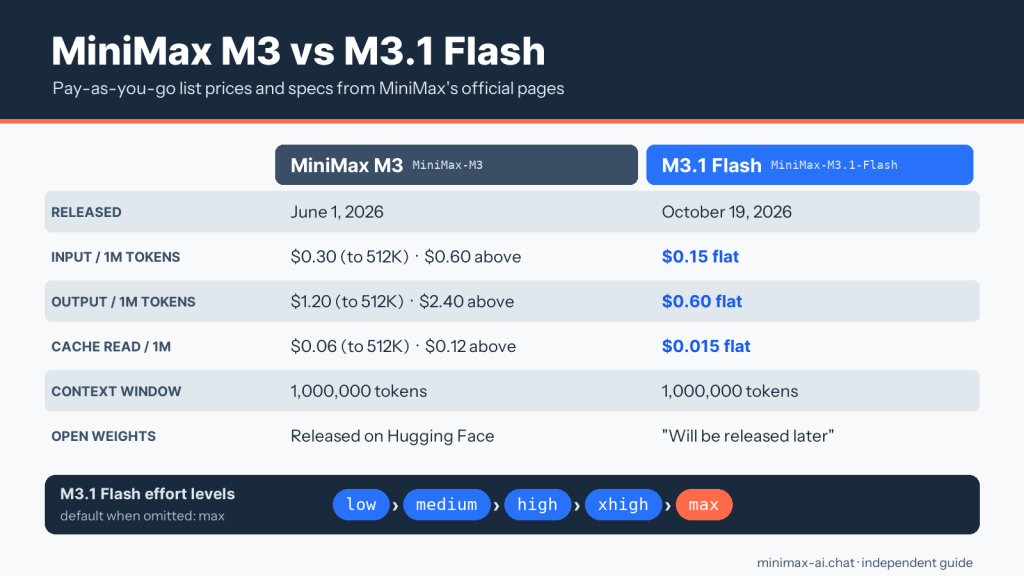
| Item | MiniMax M3 | MiniMax M3.1 Flash |
|---|---|---|
| Released | June 1, 2026 | October 19, 2026 |
| Input / output per 1M | $0.30 / $1.20 up to 512K input; $0.60 / $2.40 above | $0.15 / $0.60 at any length |
| Cache read per 1M | $0.06 / $0.12 | $0.015 |
| Priority tier | Yes, at 1.5× Standard | Not listed |
| Context | 1,000,000 tokens | 1,000,000 tokens |
| Inputs | Text, images, video | Text, images, video |
| Thinking | Can be enabled or disabled; defaults differ by endpoint | Always on; five effort levels, default max |
| Open weights | Published on Hugging Face (MiniMaxAI/MiniMax-M3) | Announced as “will be released later” |
| M Plan | Not listed by name on the M Plan pages | Included in Go, Explore, and Build |
For most new text, coding, and agent work, M3.1 Flash is the cheaper starting point, and MiniMax positions it as the faster one. M3 remains listed and still makes sense in a few cases. You may need its Priority tier, have an evaluation you must reproduce exactly, or want weights you can self-host today. Read the full MiniMax M3 guide for its license and deployment details.
Open weights and Hugging Face status
MiniMax calls M3.1 Flash an open-weight model, but its announcement says “Model weights will be released later” and gives no date. When this page was last verified, the MiniMaxAI organization on Hugging Face had no public M3.1 repository. Its newest public model repositories were Music 3, H3, and M3. That means there is no license file to read yet either; MiniMax’s earlier open models each shipped with their own license terms, so check the new repository’s license before you deploy when it appears.
Until then, “minimax m3.1 flash huggingface” searches will mostly turn up third-party pages. Use MiniMax’s API, M Plan, or MiniMax Code, which are the routes MiniMax itself lists.
Limits to keep in mind
- Vendor numbers only. Benchmark and speed figures are MiniMax-reported; no independent replication has been published here.
- No self-hosting yet. Weights are announced but not published.
- Thinking is mandatory. Every call spends reasoning tokens; lower the effort level for simple work.
- No Priority tier listed. If you need priority admission, MiniMax currently lists it for M3 only.
- A bigger model is coming. MiniMax says a Pro version “will also arrive later,” so expect the lineup to change again.
MiniMax M3.1 Flash FAQ
When was MiniMax M3.1 Flash released?
October 19, 2026. It replaced the earlier M3.1-Flash-Preview build, which MiniMax has now retired.
How much does MiniMax M3.1 Flash cost?
On the pay-as-you-go API, $0.15 per million input tokens, $0.60 per million output tokens, and $0.015 per million cache-read tokens, with no long-context surcharge. It is also included in M Plan, from $22 a month.
What are the MiniMax M3.1 Flash benchmark scores?
MiniMax reports 73.7 on DeepSWE v1.1, 62.8 on Automation-Bench v1.0.6, 61.7 on OSWorld 2.0, 29.6 on Agents’ Last Exam, 76.2 on BankerToolBench, 82.2 on CyberGym, and 43.4 on HLE without tools. These are MiniMax-reported results, not independent tests.
Is MiniMax M3.1 Flash on Hugging Face?
Not yet. MiniMax says the weights “will be released later” and has not given a date. When this page was last verified, the MiniMaxAI organization had no public M3.1 repository.
What happened to M3.1-Flash-Preview?
MiniMax retired it. Requests that still use the name MiniMax-M3.1-Flash-Preview are served by MiniMax-M3.1-Flash.
Is MiniMax M3.1 the same as M3.1 Flash?
For now, yes. M3.1 Flash is the only M3.1 model MiniMax has released. MiniMax says a Pro model will arrive later.
What is the context window?
1,000,000 tokens, with text, image, and video input.
Can I turn off thinking?
No. The API returns a 400 error if you try. Use a lower effort level, such as low or medium, to cut latency and cost.
Was “Space Bunny” MiniMax M3.1 Flash?
MiniMax says so. Its announcement states that Space Bunny, which processed more than 200 trillion tokens while operating anonymously, was an early version of M3.1 Flash.
Does the chat demo on this site use M3.1 Flash?
No. The short-text demo on the MiniMax-AI.chat homepage does not use M3.1 Flash.
Official sources and verification
Last verified: October 21, 2026
- MiniMax M3.1 Flash announcement (October 19, 2026): benchmarks, speed, pricing, availability, open-weight plans, Space Bunny.
- MiniMax model release notes: release date and description.
- Text-generation guide: model name, context, inputs, effort levels, thinking limits, base URLs.
- Pay-as-you-go price list: M3.1 Flash and M3 rates.
- Rate limits and M Plan overview: limits, plan coverage, preview retirement.
- MiniMaxAI on Hugging Face: open-weight status.
Browse the full lineup in the MiniMax models directory, or send a correction through our contact page.